Mỹ nâng Tariff – Lợi & Hại?
By Le Hoang
/ 9. July 2025
Từ thời Trump đến Biden, rồi quay lại Trump, xu hướng nâng thuế nhập khẩu, đặc biệt với Trung Quốc...
Read More
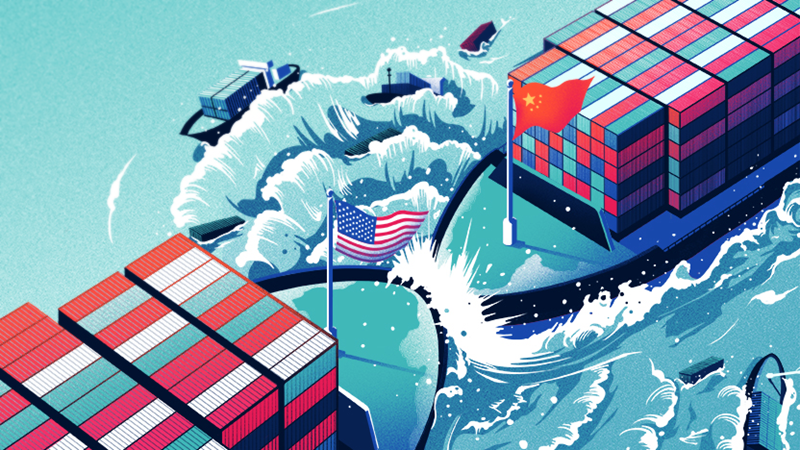






Forecast of 4 development steps of the US-China trade war
First step: Trade war
From March 2018, President of the United States (US) D. Trump announced plans to impose tariffs on goods from China into the US, up to 60 billion USD per year. The purpose is to combat trade imbalances between the two countries. So far, the US has taxed 10%, 25% for more than 6000 Chinese products exported to the US, with the tax amount up to 250 billion USD. In response, China has also set tariffs on 110 billion USD worth of 5000 US export products to China. Thus, the US taxed nearly 50% of Chinese goods exported to the US and China has taxed 85% of the amount of US goods exported to China. The ball is on the Chinese side. If China does not find radical solutions, it is feared that the US will continue its trade war with China.
Second step: Technology war
To prove that he will keep the promise when running for election, which was to curb the rise of the Chinese industry, President D. Trump’s first job is to strike “surgical attacks through tax increases” for products targeted in the “Made in China 2025” plan. The first list of 818 imported products with value of 34 billion USD will incur an additional fee of 25% from July 6th, 2018. The second list includes 284 products, with a not yet decided tax increase. In this list, there are no consumer goods.
For technology items, the US goal is far from a punitive measure. It is to limit China’s progress by preventing technology transfer for this country. The Chinese market has always been a dream destination because it is profitable and Beijing allows foreign enterprises to approach its market with the requirement to cede technology. Since President Trump came to power, he has resolutely enforced a policy against China’s violation, acquiring and buying technology rights, especially American high technology. As a result, for the past two years, American enterprises have been more hesitant when deciding to do business with China. Regarding Chinese enterprises, they invest abroad to reach the world’s resources and high technology, including the US. From 2014-2016, Chinese businesses invested more in the US than US businesses invest in China, followed by China’ spy activities to steal high technology. Hence, the US was the first country in the West to make a strong attack on the “Made in China 2025” plan.

The third step: war in the monetary and financial sectors
Right in the presidential campaign statement (2016), Mr. D. Trump especially criticized China’s “monetary manipulation” policy. He said that: “China poses three major threats to the United States through its excessive currency manipulation… with the aim of boosting its exports and destroying American industries. With the manipulation of the RMB and its low valuation, China can sell goods to other countries at very much lower prices than an American company”. Therefore, Mr. D. Trump’s responsibility is to “end the Chinese manipulation of currency”.
It is very likely that the US will have a war on exchange rates, currencies, and finance with China. If that happens, the scenario of a deep economic crisis for China is possible because the implications of a war on money and finance will be huge.
Fourth step: The total economic war
After conducting wars on trade, technology, exchange rates, the US will launch its fourth war, a “total war” against China’s entire economy after over 40 years of China’s open door reform policy, when all of their economic and political sectors relied on the US, but with wisdom, China enriched “on the back” of the US.
The consequences of a trade war have made the Chinese economy of 2018 worse. China’s economic growth in 2018 was the lowest in nearly 30 years, reaching only 6.6% GDP growth. The level of public debt is up to 28,000 billion USD. Due to inefficient investment, overproduction, backlog goods, foreign investors in China have moved to neighboring countries around China. The situation of large budget deficit and increasing unemployment rate indicates that China’s economy is showing signs of “hard landing”. Forecast of 2019, China’s economic growth will continue to decline.
The economic decline as a consequence of the economic war with the US has forced China to change its growth model, accept growth to “soft landing”, sustainable growth, shift from large investment, export to reduce investment, boost domestic consumption and change quality … That is the only option of China in the new period.
By launching an economic war called “making America great again”, President D. Trump broke the structure of the world order that the US had built since the end of World War II, and replaced with a new order, of which the US, like the nineteenth-century England, would have no ally or permanent enemy, but only the benefits above all. And the US economic war will last up to 20 years as predicted by Jack Ma, president of Alibaba Group? The answer probably still relies on China’s “concessions” and America’s next response plans. All happenings are still in hope./.

Views: 0
The Mekong is Southeast Asia’s longest river and the twelfth-largest in the world. It originates in Tibet, flows through the Chinese province of Yunnan, and continues southward across or alongside Cambodia, Laos, Myanmar, Thailand and Vietnam – half of ASEAN’s ten member states – before flowing into the South China Sea. The five ASEAN countries and the Chinese provinces of Yunnan and Guangxi, spanning some 2.6 million square kilometres and 326 million people, constitute the sub-regional grouping called the Greater Mekong Subregion (GMS).

Mekong river
Soon after the Cold War ended, a window of opportunity for reconciliation opened on the formerly war-torn Southeast Asian mainland. Since 1992, and for more than a quarter-century thereafter, the Asian Development Bank (ADB) has been helping the six participating countries cooperate in the development of the GMS by funding projects in the fields of transportation, energy, telecommunications, trade, investment, education, environment and many other sectors. The GMS has emerged as one of the most effective schemes in terms of facilitating cooperation among states that had previously been prevented from engaging in meaningful economic and political exchanges – in this case as a result of the confrontational structures of the Cold War.
Besides all this, during the last decade China has transformed from a mere participant in the GMS to being its most active and, as some note, dominant member.
Unlike China’s unilateral, state-led Belt and Road Initiative (BRI), the GMS programme for facilitating and expanding the movement of goods and people across the sub-region’s borders is multilateral and has taken a more market-based approach to building and improving regional infrastructure. In China’s discourse on the BRI the GMS has taken centre stage. The landlocked Yunnan Province, until recently a remote and backward province of China, has now emerged as a New Silk Road hub and as China’s strategic bridgehead into mainland Southeast Asia with the ultimate goal of connecting it to the Bay of Bengal and the wider Indian Ocean region.
However, Beijing’s interest in enhancing connectivity in the Mekong sub-region pre-dates the BRI.
In 2010, China signed a preliminary agreement with Laos and Thailand to build a high-speed railway from Kunming (Yunnan) to Bangkok that could eventually extend through peninsular Malaysia to Singapore. The section that China would build through Laos would be financed through Chinese loans then worth US$7 billion – a sum larger than the entire country’s GDP.
In the course of further plans, negotiations, disagreements and delays, the proposed railway from Singapore to Kunming broadened – on paper – into a larger network. A stem from Singapore to Bangkok would open into three separate lines north of the Thai capital, each of them ending in Kunming: one through Myanmar, another through Laos, and a third through Vietnam.
In 2014, the authorities in Myanmar cancelled the US$20 billion project to build the western branch of the railway through their country due to growing public resistance to Chinese influence. Ironically, this pushback was partly enabled by an earlier relaxation of repressive rule. Nonetheless, it did not deter Beijing. Since 2015 China has also been pushing a proposed railway linking Kunming to Kolkata via Mandalay that would require the support of the three countries en route: Myanmar, Bangladesh and India.
China’s enthusiasm for regional infrastructure is both economic and strategic in character. The proposed linkages would convey Chinese goods to foreign markets, bring needed resources into China, and speed the development of relatively poor Yunnan. Already since 2015, pipelines have been funnelling oil and gas from the Bay of Bengal through Myanmar straight to Kunming. Further, this infrastructure link de facto amounts to an insurance policy against the possible closure of the Malacca Strait – the so-called Malacca Dilemma. The Myanmar-Yunnan rail connection would open this southwestern backdoor for trade and transport even wider for Beijing’s compensatory use should a hostile power ever block China from using the South China Sea.
Concepts such as the ‘Mekong Mode’, depicting a naturally given and regionally accepted Chinese pre-eminence in the Greater Mekong Subregion, evoke a sense of newly won self-confidence and send a strong signal to the outside world that China is able and willing to provide leadership in Southeast Asia. Leadership in international relations can only emerge and be institutionalised if the dominant regional power is willing and able to assume the responsibilities associated with it.
Another precondition for regional leadership is being acceptable as a regional leader in the eyes of the medium and small powers. China’s approach to the GMS has strengthened Beijing’s quest to lead and demonstrates that the country possesses both the economic resources and the political will to assume this regional leadership role.
However, while the acceptance of a prominent Chinese role in the GMS and the wider Southeast Asian region has grown within the region itself, ASEAN governments – albeit to varying degrees – are not yet prepared to put all their eggs in the China basket at the expense of weakening their respective relations with the United States, Japan and, to a lesser extent, the European Union. Given that all these international actors are also important stakeholders in the GMS sub-region, a regional Pax Sinica is not (yet) on the horizon./.
(theasiadialogue.com)
Dr Joern Dosch is Chair of International Politics and Development Cooperation at the University of Rostock.
Views: 0
Bước thứ nhất: Chiến tranh thương mại
Từ tháng 3/2018, Tổng thống Mỹ D.Trump đã công bố kế hoạch áp thuế quan đối với hàng hóa đến từ Trung Quốc (TQ) vào Mỹ, lên đến 60 tỷ USD mỗi năm. Mục đích nhằm chống lại sự mất cân bằng thương mại giữa hai nước. Cho đến nay, Mỹ đã đánh thuế 10%, 25% cho hơn 6000 mặt hàng của TQ xuất khẩu vào Mỹ, với số tiền đánh thuế lên đến 250 tỷ USD. Đáp lại, TQ cũng đã đánh thuế 5.000 mặt hàng của Mỹ xuất khẩu vào TQ, với trị giá 110 tỷ USD. Như vậy, Mỹ đã đánh thuế gần 50% hàng hóa TQ xuất khẩu vào Mỹ. Còn TQ đã đánh thuế đến 85% số lượng hàng hóa Mỹ xuất khẩu vào TQ. Quả bóng đang ở sân phía TQ. Nếu TQ không tìm ra những giải pháp căn cơ, e rằng Mỹ sẽ tiếp tục cuộc chiến tranh thương mại với TQ.

Bước thứ hai: Chiến tranh công nghệ
Để chứng tỏ sẽ giữ lời hứa khi ra tranh cử, đó là kiềm chế sự trỗi dậy của ngành công nghiệp TQ, việc làm đầu tiên của Tổng thống D.Trump là ra những đòn “tấn công phẫu thuật, thông qua việc tăng thuế đối với các mặt hàng được nhắm đến trong kế hoạch “Made in China 2025”. Danh sách thứ nhất gồm 818 mặt hàng, trị giá 34 tỷ USD nhập khẩu, phải chịu thêm một khoản phụ phí 25% kể từ ngày 6/7/2018. Danh sách thứ hai gồm 284 mặt hàng, với mức tăng thuế chưa được quyết định. Trong danh sách này, không có các mặt hàng tiêu dùng.
Đối với các mặt hàng công nghệ, mục tiêu của Mỹ còn đi xa hơn nhiều so với một biện pháp trừng phạt . Đó là hạn chế những bước tiến của TQ bằng cách ngăn chặn hoạt động chuyển giao công nghệ cho nước này. Thị trường TQ luôn là nơi được mơ ước vì mang lại nhiều lợi nhuận và Bắc Kinh cho phép doanh nghiệp nước ngoài tiếp cận với yêu cầu phải nhượng lại công nghệ. Từ khi Tổng thống Trump lên nắm quyền, ông kiên quyết thực hiện chính sách chống lại việc TQ vi phạm, thâu tóm, mua bán bản quyền công nghệ, đặc biệt là công nghệ cao của Mỹ. Vì vậy, hai năm qua, các doanh nghiệp Mỹ đã do dự hơn khi quyết định làm ăn với TQ. Còn phía doanh nghiệp TQ, họ đầu tư ra nước ngoài nhằm mục tiêu tiếp cận nguồn tài nguyên và công nghệ cao của thế giới, trong đó có Mỹ. Từ năm 2014-2016, các doanh nghiệp TQ đã đầu tư vào Mỹ nhiều hơn các doanh nghiệp Mỹ đầu tư vào TQ, kéo theo đó là việc TQ tiến hành các hoạt động gián điệp nhằm ăn cắp công nghệ cao. Vì vậy, Mỹ là nước đầu tiên ở phương Tây thực hiện cuộc tấn công mạnh mẽ vào kế hoạch “Made in China 2025”.
Bước thứ ba: chiến tranh trong lĩnh vực tiền tệ, tài chính
Ngay trong tuyên ngôn tranh cử Tổng thống Mỹ (năm 2016), ông D.Trump đã đặc biệt phê phán chính sách “thao túng tiền tệ” của Trung Quốc, ông nói “Trung Quốc đưa đến ba mối đe dọa lớn đối với Mỹ khi thao túng tiền tệ quá đáng…với mục đích đẩy mạnh xuất khẩu của họ và hủy hoại các ngành công nghiệp của Mỹ. Với việc thao túng đồng Nhân dân tệ và định giá thấp nó, Trung Quốc có thể bán hàng cho các nước khác với giá thấp hơn rất, rất nhiều so với một công ty Mỹ”. Vì vậy, “trọng trách của ông D.Trump là phải “chấm dứt trò thao túng tiền tệ ” của Trung Quốc.
Rất có thể Mỹ sẽ có cuộc chiến tranh về tỷ giá, tiền tệ, tài chính với Trung Quốc. Nếu điều đó xảy ra, kịch bản về một cuộc khủng hoảng kinh tế sâu sắc đối với Trung Quốc là hoàn toàn có thể. Bởi vì hệ lụy của một cuộc chiến tranh về tiền tệ, tài chính sẽ rất lớn.
Bước thứ tư: Chiến tranh kinh tế toàn bộ
Sau khi tiến hành các cuộc chiến tranh thương mại, công nghệ, tỷ giá tiền tệ, Mỹ sẽ phát động cuộc chiến tranh thứ tư, tiến hành “chiến tranh tổng lực” chống lại toàn bộ nền kinh tế của Trung Quốc qua hơn 40 năm tiến hành cải cách mở cửa, tất cả các lĩnh vực kinh tế, chính trị của họ đều dựa vào Mỹ, nhưng với sự khôn khéo, Trung Quốc đã làm giàu “trên lưng” nước Mỹ.
Hậu quả của một cuộc chiến tranh thương mại đã khiến nền kinh tế Trung Quốc nam 2018 bị sụt giảm nghiêm trọng. Tăng trưởng kinh tế Trung Quốc năm 2018 thấp nhất gần 30 năm qua, chỉ đạt mức 6,6% GDP. Mức nợ công lên đến 28.000 tỷ USD. Đầu tư không hiệu quả, sản xuất dư thừa, hàng hóa tồn đọng, không tiêu thụ được. Các nhà đầu tư nước ngoài ở Trung Quốc đã chuyển ra các nước láng giềng xung quanh Trung Quốc. Tình trạng thâm hụt ngân sách lớn, tỷ lệ thất nghiệp gia tăng. Kinh tế Trung Quốc đang có dấu hiệu “hạ cánh cứng”. Dự báo năm 2019, tăng trưởng kinh tế Trung Quốc còn tiếp tục bị suy giảm.
Sự suy giảm kinh tế do hệ lụy của cuộc chiến tranh kinh tế với Mỹ đã buộc Trung Quốc phải thay đổi mô hình tăng trưởng, chấp nhận tăng trưởng để “hạ cánh mềm”, tăng trưởng bền vững, chuyển từ đầu tư lớn, xuất khẩu nhiều sang giảm đầu tư, đẩy mạnh tiều dùng trong nước, phải thay đổi về chất… Đó là cách lựa chọn duy nhất của Trung Quốc trong giai đoạn mới hiện nay.
Bằng việc khởi động một cuộc chiến tranh kinh tế mang tên “làm cho nước Mỹ vĩ đại trở lại”, Tổng thống D.Trump đã phá vỡ cấu trúc của trật tự thế giới mà Mỹ đã xây dựng từ cuối Chiến tranh Thế giới thứ hai, và thay thế bằng một trật tự mới, mà ở đó Mỹ, cũng giống như ước Anh thế kỷ XIX, sẽ không có đồng minh hay kẻ thù vĩnh viễn, mà chỉ có những lợi ích là trên hết. Và cuộc chiến tranh kinh tế Mỹ – trung liệu có kéo dài đến 20 năm như dự báo của ông Jack Ma, chủ tịch Tập đoàn Alibaba hay không? Điều đó có lẽ còn phải trông chờ vào sự “xuống thang” của Trung Quốc, và những kế hoạch giáng trả tiếp theo của Mỹ. Mọi diễn biến vẫn ở thế hi vọng./.
Views: 0
The sovereignty dispute over the Paracel Islands in the South China Sea between Vietnam and China has lasted for 45 years, which is one of the longest disputes between claimants over the same islands. This is also a complicated dispute without any legal or political solution so far, somehow more complicated with repeated tensions and settlements followed by growing flares up since the Chinese side attempts to change the status quo by deliberately changing the form of the islands, expanding long-term occupation in more and more waters in order to gain control of the trade flows in the South China Sea. At the same time, China deliberately seeks to take the Paracel Islands as a naval base for protecting its mainland from far away, or as a springboard to attack its neighboring countries.
After the Chinese navy took the Paracel Islands by force from the Republic of Vietnam in January 1974, the Government of the Democratic Republic of Vietnam (later the Socialist Republic of Vietnam), the legitimate successor of sovereignty over the Paracel Islands, has repeatedly presented evidence of Vietnam’s legitimate and lawful sovereignty; strongly protecting its national sovereignty and demanding China to return the islands to Vietnam. Vietnam has also adopted a series of peaceful measures in resolving disputes with China, including friendly meetings at all levels, discussions with China’s relevant agencies, sending correspondences and notes, organizing private and public meetings, sharing information with international public and the United Nations… Despite these measures, the Chinese side did not stop but rather make more provocative actions, encroaching on Vietnamese sovereignty, running against international conventions and ethics in relations with neighboring countries, which are showcased by the following noticeable actions:
On March 14, 1988, China put naval forces at war with Vietnam’s on-duty forces at six groups of islands and reefs in Spratly archipelago including Fiery Cross, Cuarteron, Gaven, Hughes/Hugh Reef, Johnson and Subi Reefs. With advantages of large army and vessels, China occupied these islands and reefs.

Photo: China’s first entirely home-built aircraft carrier began sea trials earlier this year (Source: Internet)
On February 25, 1992, China passed the Law on Territorial Sea of the People’s Republic of China, which not only asserted China’s claim to the Paracel and Spratly Islands but also reiterated its claims to almost the entire South China Sea, from Taiwan to James Shoal in Borneo’s offshore.
On May 8, 1992, China unreasonably allowed its partner, Crestone Company from the US, to conduct oil exploration in Vanguard Bank area within Vietnam’s continental shelf.
On May 15, 1996, China joined the 1982 United Nations Convention on the Law of the Sea and pledged to settle disputes “in accordance with recognized international law.” However, on the same day, China announced an ordinance to expand its territorial sea, which applied the baseline mapping of the archipelago nations to the Paracel Islands. This action was regarded by scholars in Southeast Asia as “inconsistent”, a topic for questioning at ASEAN meetings then.
On June 21, 2012, China blatantly declared the establishment of “Sansha city” with Woody Island as its capital, with the 9-dash line including Paracel and Spratly Islands as the administrative boundary. A city with an administrative size that accounts for 80% of the South China Sea is an unprecedented form of city in human history because it delineates millions of square kilometers of sea area into a “lake” in the city following the internal water regulation of a country, directly influencing not only the South China Sea countries but also the freedom of navigation, overflight and security of others.
On June 23, 2012, China Offshore Oil and Gas Corporation (CNOOC) issued an international bid notice for 9 oil and gas blocks located entirely within Vietnam’s exclusive economic zone and continental shelf, just 37 nautical miles off Phu Quy coast, a region that has never been in dispute with China.
On May 2, 2014, China installed the Haiyang Shiyou-981 oil rig in an area just 17 nautical miles off the south of Triton Island which is located within Vietnam’s 200 nautical mile exclusive economic zone to conduct oil and gas exploitation within Vietnam’s sovereign waters. The Vietnamese people had to spend more than two months on the sea to “kick” the rig out of Vietnam’s waters.
This is to brief blatant actions in daylight by China, acting as a big country to infringe upon the sovereignty of Vietnam and other the countries in the South China Sea, which were discovered, condemned and fought against by Vietnam. Countries in the region and the international community also observed and collectively protested these actions as irrational and illegal ones, forcing China to falter for some moments.
In addition, China also has many other tricks aimed at monopolizing control of South China Sea that are known to just a few. Without proper awareness, countries in the region with sovereignty disputes with China and even international legal and archaeological experts may be put in its traps one day, with the following actions that should be seriously noted by everyone:
Under a viewpoint and mindset that its nation’s maritime sovereignty includes both legal and historical evidences, China has always demanded international public opinion and law to consider historical factors in forming its sovereignty in the South China Sea. And to ensure that China has reliable historical evidence in the South China Sea for a long time, this evidence should appear in places where they need to. So Chinese unnumbered fishing vessels were ordered to sail offshore to silently drop Chinese ‘antique’ items that had been searched for, collected and excavated inland years ago, particularly those which are old, broken, no longer valuable but bearing the signs of previous Chinese feudal dynasties, into the waters claimed by China as “historic waters”. Then one day when a dispute breaks out, China will show countries that their “historical evidence” is already at the bottom of the sea, which will be hardly denied by these countries.
Secretly dropping ancient items into the sea sounds easy, the thing is to let them appear in other people’s land. So China opened up secret campaigns for “frogmen” to infiltrate the islands controlled by other claimants, dig and bury those items deeply under the ground. In case it is impossible to break in due to tight control, China can use money to buy locals to help them bury the items instead. Chinese fishing vessels and fishermen working at sea communicated and interacted with other countries’ fishermen and offshore fishing vessels, making them an ideal bridge to bury the “historical evidence” on targeted islands. This explained when the local governments and people took underground works on the islands that has never had any footprints of Chinese people, they were startled to find many Chinese “artifacts” under the ground without knowing when they were buried.
That’s not all but just one way to fabricate evidence for China’s sovereignty. Another way that few people know is to put carved sovereignty stones just under the disputed sites to China’s contenders’ surprises, which is done by Chinese professional divers. They secretly got onboard minisubs carrying necessary tools, quietly and secretly approaching foot of the atolls in the deep sea, checking and searching for flat coral cliffs, then drilling, sharpening, and carving into flat walls with Chinese emblem or Chinese ancient letters to “mark” its sovereignty. The true owners of those atolls can neither control the deep sea floor nor know right under their feet, they were “intruded by neighbor”.
Therefore, occasionally the Chinese media and authorities reported that they “happened” to find in this or that sea area within the ‘9-dash line’ in the South China Sea some Chinese antiques, which are excavated then noisily exhibited and communicated in order to draw the world’s attention, especially China’s “in-house” journalists and some ignorant archaeologists to come and see. These people who do not know the truth will easily accept and boast, “True! China probably has historic waters in that place.”
China’s actions in the South China Sea, both overtly and covertly, show that countries with territorial sovereignty disputes with China must be constantly vigilant to protect their lands, as people say, vigilance is never redundant. And as a Western politician who is very knowledgeable about Chinese culture and customs said, “When you shake hands with a Chinese, you have to check how many of your fingers remain”./.
Views: 0
In Chinese leaders’ eyes, the South China Sea is critical to their strategy of expanding China’s influence and making China a world power. Politically speaking, the South China Sea is where China can deploy its “soft border” doctrine and its “Look South” policy, a “vital” way for China to overcome surrounding countries such as India, Russia, Japan and Republic of Korea to expand its influence in the world, a “gateway” for China to get out of the US containment and restraint to become a world power. In economic terms, the South China Sea is abundant in natural resources which can be exploited to make an important contribution to the rapid economic development of the most populous country in the world that is falling into a serious shortage of natural resources, particularly oil. With one of the world’s busiest maritime and air routes through the South China Sea, so “who controls the South China Sea will control economic development in East Asia”. From the military angle, the South China Sea is the entry into the Asian continent for US and Japanese naval forces, which is the passage for warships from the Indian Ocean to the Pacific Ocean. The South China Sea is also home to many important islands with strategic and tactical significance at sea to keep traffics and other activities at sea in control. Islands in the area can be developed into military bases which can serve as a starting point to attack enemies as well as a belt at the frontline to defend the mainland from afar. Therefore, with control over the South China Sea, China will expand its defensive space, pushing the battlefield far away from China’s mainland. More military bases in the islands will allow China to monitor and possibly threaten military operations of Southeast Asian countries, including controlling the US military operations. In addition, controlling the South China Sea also helps China to gather strength of millions of Chinese in Southeast Asian countries, strengthening national cohesion, supporting the unification and recovery of Taiwanese territory.

Therefore, China for long has an ambition to “monopolize control of the South China Sea” through which to penetrate and dominate Southeast Asian countries in all areas of politics, economy, culture and military, thus expanding its role and influence in the Asia-Pacific region and the world. China strives to implement the “Blue Ocean” strategy with the main idea of “Open the door to the outside world, develop an outward-oriented economy in association with the right diplomatic and politic guidelines and a strong naval force to strongly support national development”. Accordingly, China sets the policy in the South China Sea to: Strengthen the defense potential, especially naval forces with capabilities to win and make deterrence at sea, a firm support for other activities to gradually take control of the South China Sea, ensuring China’s decisive role in the Asia-Pacific to become a world-class maritime power. China identifies the goal of step-by-step “reclaiming sovereignty” towards implementing “exclusive control” of the South China Sea to make way to the Pacific Ocean and facilitating access to the Indian Ocean, promoting China’s marine economic development and striving to make China a marine economic power, attaching special importance to exploiting oil and gas resources to meet domestic economic development demands, linking the “island chains” both as a boundary of self-defence and a boundary of operation. China identifies Japan – Taiwan – Hainan – Paracel Islands – Spratly Islands as the “inner island chain”, Japan – the Philippines – Kalimantan – Sri Lanka as the “outer island chain”, striving for its maritime force to be the active force in the “inner island chain” by 2010 and in the “outer island chain” area after 2010.
With this ambition in mind, China officially claims to the world that they have “sovereignty” over a large part of the South China Sea, which is delineated by a 9-dash line unilaterally drawn by China to occupy the waters of many countries in the South China Sea. China has developed and implemented a series of policies and steps to realize its ambition, with the following noticeable actions: The first is to constantly seek to legalize the claim of “sovereignty rights ” in the South China Sea; the second is to promote implementation of the “Marine Economic Development Strategy” to support the South China Sea strategy; the third is to promote implementation of oil and gas exploration and exploitation plans in the South China Sea; the forth is to strengthen the military power, with prioritized development of naval forces, air force and strategic missiles in order to control the South China Sea while preventing other countries’ interference; the fifth is to promote the policy of “setting aside disputes for joint exploitation” to divide ASEAN countries, prolonging time for the right opportunity for China to implement its strategic objectives in the South China Sea.
China’s policies and steps to implement “monopolizing control of the South China Sea” ambition in the past few decades have made the situation in the South China Sea constantly unstable. The South China Sea has become one of the hottest “hot spots” in Asia-Pacific. These policies and steps themselves lead to unexpected risks and challenges for China and its leaders, specifically:
Firstly, China’s ambition and actions have clearly revealed China’s “expansionist” ideology and ‘Great Han’ chauvinism, which have been deeply rooted for a long time from the ancient feudal China, bringing neighboring nations and people great losses and sufferings that will remind them of continued vigilance to defend their sovereignty, independence and autonomy. This is the ideology that leaders of the new socialist China took all efforts to deny and soften to build the image of a China with full responsibility, respect for legitimacy, fairness, equality and support to developing nations and peoples. Today no one believes that China and its leaders have abandoned the “expansionist” ideology, disabling China’s image improvement efforts so far.
Secondly, China’s ambitions and actions are not supported by all Chinese people who have knowledge, patriotism, respect for the right and national pride, not accepting what China is doing in the South China Sea. There have been many voices of protest in the country and critics of reputable Chinese scholars against unreasonable 9-dash line claim by the Chinese leader. That disagreement has caused serious debates among China’s social classes and partly undermined public trust in the country. Of course, Chinese leaders have to find ways to silence those opinions. However, this only leads to accumulation of latent public disagreement, which may be added by weaknesses in other areas of social life that have not been settled by the regime to make the Chinese society at risk of instability.
Thirdly, what China has done in the past few years has made themselves a direct contender with all claimants in the South China Sea. When China behaves as a big country, smaller and weaker countries must of course keep patience, even silence, to remain in peace. But that patience has its own limits since national sovereignty is very sacred and is also living space for the people of these countries. Threatened countries will be forced to build and increase military potential to ensure their defense of national sovereignty. It is natural that smaller and weaker countries will come together and support each other in the “battle” against an opponent with superior strength. They may also try to get along with other big country to get an “umbrella” in case of emergency, even joining an alliance or setting up a foreign military base in their own countries. Chinese leaders seem to have recognized this too. So they are “appeasing” these countries with China’s policy of “amity, sincerity, preferentiality, and inclusiveness“. But how to regain such amity and sincerity when its ambition remains intact?
Fourthly, for a long time, the Western media have strongly propagated the “China threat” theory with a lot of images and perspectives on a violent China, which will someday fight against other nations once it becomes a world superpower. The Chinese propaganda and communication apparatus had to operate at full capacity to rectify and reject it, arguing that it was the way the West scared people against China. Ironically, China’s ambition and actions in the South China Sea are the most specific, authentic and clear evidence of what China is doing as a threat to the world, firstly to Southeast Asian countries. It turns out what the West says is not an “exaggeration”.
Fifthly, China’s ambition and actions cannot come unnoticed by the US and Western powers. In the context of global geostrategic competition, China’s behaviors towards the South China Sea countries are unexpectedly creating opportunities for the US and the West to return to the Asia-Pacific in an open way to stop China’s “southward” pathway. The US knows what and where China’s grand strategy is, so the strategic focus to prevent China will be in the South China Sea. With the “America first” motto, the US will be willing to engage, including by military measures to protect the US citizens and “interests” in this waters. China will have to confront the US right in its “gateway.” In retrospect, has China any “allies” that are willing to join them in a “game” against the US and its powerful allies? Obviously, the “China Dream” of “the great renaissance of the Chinese nation” is hard to become true in the medium term.
The overview of five risks and challenges China will face in its ambition of “monopolizing control” of the South China Sea shows that it is not easy for China to achieve what it wants. The best way is to stop that ambition when it’s not too late./.
Views: 0
|
BA XU THẾ CẠNH TRANH CHIẾN LƯỢC BIỂN MỸ – TRUNG
Từ năm 2010, các chuyên gia Mỹ đã coi Trung Quốc (TQ) là đối thủ cạnh tranh chiến lược lớn nhất trên biển, bắt đầu có phản ứng về mặt chiến thuật, liên tục thúc đẩy các khái niệm tác chiến như “liên hiệp tiến vào và cơ động”, “tiến vào toàn khu vực”… Kể từ năm 2016 đến nay, Quân đội Mỹ đẩy nhanh việc chuyển đổi mô hình chiến lược trên biển, từ “biển tới đất liền” đến “trở về với biển”; từ tập trung chống khủng bố, bảo vệ an ninh trên biển chuyển sang cạnh tranh chiến lược trên biển với các nước lớn , trong đó không thể không nhắc đến TQ.
Hiện tại, cạnh tranh chiến lược trên biển giữa TQ và Mỹ cho thấy rõ 03 xu thế:
Một là, cạnh tranh chiến lược ngày càng gia tăng. Sự tin tưởng nhau về chiến lược trên biển giữa Mỹ và TQ ngày càng bị thu hẹp, sự hợp tác bị cản trở, ý thức cạnh tranh nhanh chóng tăng lên. Trong bối cảnh Mỹ ngày càng gây sức ép, mâu thuẫn và đối đầu Mỹ – Trung tại các điểm nóng như Biển Đông hay đảo Đài Loan chưa có dấu hiệu lắng xuống.
Hai là, phạm vi cạnh tranh mở rộng, tính chiến lược ngày càng mạnh. Đối với Mỹ, phạm vi của mối đe dọa trên biển từ TQ đã được mở rộng, tính chất được chiến lược hóa cao độ. Cạnh tranh quân sự Mỹ – Trung trước đây chủ yếu tập trung vào các lĩnh vực cục bộ và các vấn đề cụ thể, nhân tố tiêu cực trong quan hệ quân sự hai nước vẫn chưa tăng đến mức ảnh hưởng đến toàn cục.
Hiện nay, Mỹ rất nhạy cảm với các hoạt động mở rộng ảnh hưởng của TQ trên biển nên cạnh tranh chiến lược vốn có giữa hai cường quốc lớn nhất thế giới này trở nên trầm trọng hơn, không còn giới hạn ở vùng biển Đông Á. Đồng thời, không chỉ là cuộc đọ sức về thực lực quân sự mà còn liên quan đến cuộc đấu toàn diện về chiến lược, trật tự khu vực và quy tắc quốc tế.
Ba là, ngày càng nhiều nhận định về khả năng xảy ra va chạm và xung đột quy mô nhỏ. Cạnh tranh chiến lược trên biển giữa Mỹ – Trung không giống với cạnh tranh chiến lược trên biển giữa các nước lớn trong lịch sử. Cạnh tranh chiến lược Mỹ – Trung sẽ là một sự giằng co và tiêu hao chiến lược lâu dài. Tuy nhiên, không giống với sự đối đầu của Mỹ – Liên Xô men theo bức tường Berlin trước đây, cạnh tranh chiến lược trên biển giữa TQ và Mỹ có “vùng xám” rộng hơn. Điều này sẽ giảm bớt mức độ đối kháng nhưng đồng thời cũng khiến cạnh tranh càng trở nên khó quản lý hơn, càng nhiều khả năng xảy ra xung đột vũ trang quy mô nhỏ.
LIỆU MỸ – TRUNG CÓ THỂ CHUNNG SỐNG HÒA BÌNH TRÊN BIỂN?
Trong bối cảnh này, đấu tranh và xung đột lâu dài là điều khó tránh khỏi. Trước khi đạt được thỏa thuận thực sự, hai cường quốc lớn nhất thế giới cần phải tính đến cách thức làm thế nào để vượt qua giai đoạn rủi ro cai trong 10-20 năm tới. Đây chắc chắn là vấn đề lớn không chỉ cho hai nước Mỹ – Trung mà còn cho cả thế giới.
Riêng trên biển, hai bên có nhiều khả năng hình thành thế lực ngang nhau tại một số khu vực ở Tây Thái Bình Dương. Do đó, cạnh tranh chiến lược Mỹ – Trung trên biển có thể sẽ mang sắc thái tranh đấu quyền lợi rất mạnh mẽ. Để tránh xảy ra tình hình xấu nhất, quân đội hai nước Mỹ – Trung cần phải tăng cường xây dựng năng lực kiểm soát khủng hoảng nhưng quan trọng hơn là phải chuẩn bị thỏa hiệp và hợp tác trên một loạt vấn
đề quan trọng.
Trước tiên, cần phải đạt được nhận thức chình cần thiết về cơ cấu quyền lực trên biển Tây Thái Bình Dương. Tại vùng biển này, Mỹ – Trung nhất định phải thích ứng được với cơ cấu quyền lực tương đối cân bằng được tạo dựng bởi tỷ lệ sức mạnh mới.
Đồng thời hiểu rõ mặt yếu và khuyết điểm của mình, sử dụng một cách thận trọng sức mạnh và khả năng kiềm chế các hành động gây kích động, học cách chung sống hòa bình. Hai nước cần tiến hành đối thoại về khu vực Tây Thái Bình Dương càng sớm càng tốt.
Hai bên có thể tham vấn, trao đổi về ý tưởng chiến lược, tiến hành đối thoại về kiểm soát quân sự, thậm chí là hạn chế lẫn nhau liên quan đến sự phát triển vũ khí quân sự trên biển. Qua đó tạo ra sự đồng thuận cần thiết về việc phân phối quyền lực tại khu vực này.
Trong việc xử lý vấn đề có sự tham gia của nhân tố bên thứ ba, cả hai bên cần phải lý trí, tránh suy diễn. Nếu Mỹ thực sự mong muốn cùng với TQ tiến hành đối thoại chiến lược, và chính sách về vấn đề biển bao gồm cả Biển Đông thì cần phải kiềm chế và “hạ giọng” trong vấn đề chủ quyền để tạo được bầu không khí đối thoại. Trong quá trình đàm phán, TQ cần bình tĩnh hơn, không nên coi bất cứ hành động nào từ bên thứ ba đều bắt nguồn từ nhân tố Mỹ, từ đó có những phản ứng thái quá.
Cuối cùng, hai bên có thể cùng nhau tạo dựng quy tắc biển và trật tự khu vực mang tính bao dung. Bởi vì TQ và Mỹ trong tương lai đều khó mà xây dựng hoặc duy trì quyền lực chủ đạo tại khu vực này. Do đó, quy tắc hoặc trật tự trên biển của khu vực châu Á – Thái Bình Dương cần phải có sự đồng thuận của cả hai nước.
Điều này cần phải được xây dựng một cách có ý thức trong sự tương tác trên biển lâu dài giữa TQ và Mỹ. Hai bên đểu cần phải từ bỏ ý đồ và kế hoạch xây dựng cơ chế an ninh trên biển nhắn vào đối phương tại Tây Thái Bình Dương , thậm chí là Ấn Độ – Thái Bình Dương.
Cùng với các sự kiện đụng độ tàu thuyền và máy bay giữa TQ và Mỹ nhanh chóng gia tăng, hai bên cũng cần phải đưa ra quy phạm về hành động quân sự, cùng chung sống tại khu vực này./.
|
|
|
Views: 0
China’s ambition to “monopolize control” of the South China Sea is not only having command over the waters adjacent to Vietnam, the Philippines, Malaysia… in the South China Sea but also controlling waters thousands of kilometers away from China such as those close to Indonesia’s Natuna Islands. Although Indonesia has been vigilant, reacting fiercely and striving to protect its territorial sovereignty, it seems that their measures are not strong enough to stop China’s ambition.

(Location of Natuna islands)
The Natuna Islands, which belongs to Riau Province of Indonesia, consists of 272 large and small islands, located in the South China Sea, between the Malay Peninsula and the Borneo Peninsula and surrounded by a vast sea area with the population of more than 100,000. The archipelago has a wide range of resources such as marine produces, seafood, oil and gas reserves, and diverse ecosystems. The Natuna Islands stand in an important maritime route through the South China Sea, which connects the Strait of Malacca with the Java Sea. This is a lifeline route connecting the Pacific Ocean with the Indian Ocean; Europe, the Middle East and Africa with Asia, South Asia and Southeast Asia. Over a quarter of the world’s goods are shipped via this route. It is also a critically strategic trade route of Northeast Asian economies such as China, Taiwan, Japan and South Korea. Besides, the Natuna Islands are considered a special strategic location in monitoring activities in the South China Sea, including military and maritime security activities
In theory, the waters around the Natuna Islands in the southern part of the Malacca Strait have nothing to do with the territorial waters that China claims sovereignty over, because it is too far away from Chinese territory, over a thousand kilometers. According to the United Nations Convention on the Law of the Sea, it is three times further than the distance that China can claim. But the problem here is that China issued the statement on a “9-dash line”, the tip of which overlaps with Indonesia’s exclusive economic zone (EEZ) in the waters of the Natuna Islands. Beijing did not clarify its position on Indonesia’s exclusive economic zone in that area. Therefore, the exclusive economic zone that Indonesia claims currently has a no-small area overlapping with the waters within the “9-dash line” that China deliberately draws to claim its sovereignty in the South China Sea. According to China’s explanation, this sea area is both a historic area with the “Maritime Silk Road” established by Chinese many centuries ago, and a long-standing “traditional fishing grounds” of this country’s fishermen. On that basis, China began to eye and encroach this sea of Indonesia.
It must be said that, from a strategic angle, generations of the Chinese leadership have targeted Southeast Asia and its surrounding waters, and planned to gain control over this area for a long time. Mao Zedong’s statement that “I will lead 500 million Chinese farmers to march south” after the establishment of the People’s Republic of China was very typical of the Chinese leaders’ intention to control Southeast Asia. Accordingly, the Islands of Natuna and its surrounding waters in the South of the South China Sea are also located in the South China Sea. Having control over the entire South China Sea could help China quickly increase the number of commercial goods shipped, reducing the costs and ensuring more safety than using other routes. On the way for China to become a world power, the South China Sea maritime route from the Natuna Islands to the Malacca Strait will be vital to the Chinese economy, and therefore, it needs to manage this route itself to strengthen national security and expand its existence space.
Therefore, on the one hand, China insists on its long-time stance on the irrational “9-dash line” and throws allegations and fabricated documents on historical “evidence” for the so-called “traditional fishing grounds”. On the other hand, it has promoted field activities at sea, such as sending fishing vessels into the Natuna waters to exploit seafood, forcing Indonesia to react, turning “non-disputed waters into disputed waters” to gain public support. However, China’s desire has not been supported by countries in the region. In November 2015, after Indonesia announced that it could sue China to the International Criminal Court if the dispute in the Natuna Islands could not be solved by dialogue, China stated that it has no objection to Indonesia’s sovereignty over the Natuna Islands. But in return, Indonesia must reaffirm that it has no territorial claim to the Spratly Islands in the South China Sea, which is called Nansha Islands by China. They hoped this way would help put Indonesia out of the sovereignty disputes in the Spratly Islands, leaving the strongest claimant Vietnam alone, allowing China to break the bundle of sticks one by one.
Although China publicly acknowledged Indonesia’s sovereignty over the Natuna Islands in the South China Sea and that “it had no problem to be solved with Jakarta”, it also said that this was not applied to Natuna’s exclusive economic zone. One of China’s major strategies is to gain control over the arteries of global trade, especially the maritime routes in the South China Sea, in order to increase its power. Therefore, along with the continuation of the declaration of the “9-dash line” and the disputes over the seas and islands with Vietnam and the Philippines, etc., China keeps on using the concept of “historical sovereignty” and “traditional fishing grounds” to justify the violations by its fishing boats, maritime surveillance and coast guard vessels in the Natuna waters. Since early 2016, China has made a series of violations into the exclusive economic zone of the Natuna Islands, i.e. collisions between Chinese and Indonesian vessels, diplomatic and legal disputes and statements relating to Indonesia’s maritime sovereignty. Typically, on June 17, 2016, the Indonesian Navy was forced to fire a warning against 12 Chinese fishing vessels operating in the waters off the Natuna Islands, arrested the fishing boat Yu 19038 and 7 crew members. Immediately, the Chinese Ministry of Foreign Affairs vehemently protested, arguing that Indonesia’s maritime forces used force to injure Chinese crew members, and asserting that Chinese fishing vessels have the right of free fishing in “Chinese traditional fishing grounds”. Chinese Foreign Ministry spokesperson Hua Chunying said: “China and Indonesia have overlapping claims on maritime rights and interests.” To protect this position, on June 24, 2016, Chinese Navy sent the No. 409 Fleet (including attack submarines, guided-missile destroyers and rescue ships) to the Banda Aceh Sea, in the North of the Natuna Islands, to observe and protect its fishing vessels. Public opinion in Indonesia and other countries in the region had to consider this as a new Chinese move to increase pressure on Indonesia while the two countries often had “collisions” around the Natuna Islands.
It could be said that China’ continuous ambiguous messages on the limits of sovereignty over the Natuna Islands as well as its ‘salami slicing’ tactic by actively creating small collisions and slowly intervening to avoid strong reactions from the opponents, thus leading to a strategic change on the field, have made Indonesia somehow confused. So far, the Indonesian Government has always been lack of initiative in dealing with and proposing appropriate solutions to maritime sovereignty issues, including the control of the exclusive economic zone of the Natuna Islands. There are also different views within the Indonesian government itself on choosing between economic and political interests in its relations with China. Beijing clearly understands this and is taking active advantage of Jakarta’s weakness to gradually take the upper hand in turning Indonesia’s legitimate EEZ and continental shelf from a non-dispute area into a disputed zone with China.
On this, experts from the Indonesia’s Centre for Strategic and International Studies noted: “As the right time arrives, the notion of historical sovereignty plus a prepared reservation of some provisions of the 1982 UNCLOS will help China make new statements to legitimize the so-called 9-dash line and as such, a no-small portion of the Natuna Islands falls into Chinese territory as a matter of fact.” The commander of the Western Fleet of the Indonesian Navy, Rear Admiral A. Taufiq, pointed out: “When a country claims sovereignty over a territory, it must be present there. The Chinese way is to deploy fishing boats to the Natuna Islands in the form of illegal fishing, creating real-scene evidences to claim sovereignty in the South China Sea”.
Thus, by its ambiguous attitude in the recognition of Indonesian sovereignty over the Natuna Sea, combined with the regular penetration of fishing boats, maritime surveillance and coast guard vessels in the territorial waters of Indonesia, turning a non-disputed sea into a disputed one, progressively claiming sovereignty over the Natuna Islands, China has been taking steps to realize “total sovereignty” over the South China Sea, notwithstanding the waters belongs any Southeast Asia countries. In this situation should Southeast Asian countries ride a lone horse in the fight with China for sovereignty over islands and waters?
Views: 0
Views: 0
Views: 0


Views: 0


Views: 0
Global Geopolitical Trends and External Factors that Impact the ASEAN
To be able to comprehend the influence of global trends on the situation in East Asia in greater detail, it is appropriate to recall the “Three Grand Imperatives of Imperial Geostrategy” formulated by Zbigniew Brzezinski, which he believes are to prevent collusion and maintain security dependence among the vassals, to keep tributaries pliant and protected, and to keep the barbarians from coming together”. This is the exact logic followed by the US in its foreign policies, however, even under the most favorable conditions after the end of the Cold War, the US failed to ensure either financial stability or security in the world. The ultimate result was that themajor global trends are currently as follows: a change in the balance of forces, the political crisis and a split within the US elites, gradual weakening of the American posi-tions, crisis of legal mechanisms on the international are-na, the growth of regional conflicts. This provides a clue to the understanding of what has been happening at the regional level in East Asia.

Modern Regional Geopolitics and Inner Conditions within the ASEAN
The situation in the security field in East Asia has revealed a conspicuous tendency towards deterioration, because of the aggravation of geopolitical controversy. The East Asian segment of the Eurasian Arc of Instability, which embraces North East and South East Asia, features a process of a gradual reopening of the old territorial disputes and the stirring of new ones, hence, the situation has been developing in the direction of uncontrollable regional destabilization. The reason for that is “to keep the barbarians from coming together”. With this end in view, migration flows and terrorist acts are planned, new hotbeds of tension are created. All this is vividly illustrated by the broad transcontinental front stretching from North Africa to East Africa, and also by a lower, regional level front stretching from East Asia and North Korea to the South China Sea, and also from Myanmar to the Phil-ippines. The essence of such policy is to build up a clandestine system of managing conflicts among other nations.
The Northern wing of the East Asian segment of the Eurasian Arc of Instability lies from the North to the South across contended territories from the Kuril Islands through partitioned Korea and partitioned China to Vietnam, where, as a result of the Indochina wars, it was possible to reunite continental Vietnam and to alter the configuration of the central element of this segment, by shifting it southwards. During the Cold War, the conflicting parties made a lot of investment into the installation of a deeply echeloned defense, which is impossible to break by the Armed Forces formations without suffering severe losses nowadays. The conflicting parties are actively engaged in the modernization and upgrading of the Armed Forces, therefore, the region, overall, has been a platform for the unprecedented arms race. China’s growth, that has been in evidence over the recent dec-ades, has altered the balance of power in favor of Beijing, but this has brought about a vehement opposition in Washington. The fact that China, as a rising power, has blatantly disregarded the interests of small and medium-sized regional nations, has prompted those nations to seek patronage from the US, which tried to build up an anti-Chinese coalition back in the 2010s. The component exposed to the highest degree of security vulnerability is the maritime zone of the South China Sea (SCS), whose uncertain legal status is prone to trigger more fierce terri-torial controversy among the five contenders. In the 20th century, the PRC made several attempts to bolster its influence in the SCS: in 1956 (by capturing the Eastern sector of the Paracel Islands), in 1974 (by capturing the Western sector of the Paracel Islands), in 1988 (by intruding in the Spratly Islands). Currently, the PRC is engaged in the expansion of its zone of control and in the building of artificial islands in the area of Spratly Islands, where elements of military infrastructure have been deployed.
At present, we can witness the growth of tensions at various wings of the East Asian segment: the Russian Armed Forces growing presence in the Kuril Islands, the unstable situation in the Korean peninsula, the arms race on both sides of Taiwan Strait, likewise around the South China Sea, reaching the level of military confrontation of the government forces against religious radicals in My-anmar and in the Philippines. On the Western and Eastern flanks of the East Asian segment, the process of active formation of new conflict zones is well underway, it is closely related to the uncontrollable migration flows from Bangladesh towards Myanmar and Thailand. Those flows moving across the territories from Bangladesh to the Philippines have fueled the growth of influence of radical terrorist groups which are funded from the Persian Gulf. Owing to the technologies of hybrid and information wars, as well as provocations and the now-traditional employment of fake news by the Western me-dia, small local conflicts can have wide-ranging repercussions on a global scale. At the same time, from the point of view of geopolitical analysis, the anti-Chinese nature of such crises and the active involvement of external forces are visible in all attempts to instigate them.
The ASEAN member states have demonstrated their total inability to cope with the external interference in the field of resolving sectarian conflicts. A while ago, East Timor was separated from Indonesia under the pressure from the West. Similarly, the current crisis underway in Myanmar shows that the number of those who want to participate in the “butchering” of yet another regional victim exceeds the number of those who really want to help.
Today, this “conflict of civilizations” that was fueled from outside, has split the ASEAN on the basis on faith, which, of course, significantly reduces the potential to resist the external pressure put to bear by Beijing and Washington, and also to develop a coherent stance within South East Asia. Under an increasing geopolitical pres-sure from the radical extremist groups, a new Islamic Arc is being currently formed in the Southern part of the South China Sea, it runs from the South of Myanmar through Thailand, Indonesia and Malaysia to the Southern areas of the Philippines. In the aftermath of the major ISIS bases being defeated in Syria and Iraq (this terrorist organization is banned in Russia), the religious radical elements from South East Asia are actively involved in discussing plans for the establishment of the ISIS capital in the Pattani province (Thailand), the state of Sarawak (Malaysia) or the Mindanao island (the Philippines). Under such circumstances, predominantly Buddhist countries of continental South East Asia have begun the discussion about building up an alternative project of a Buddhist Confederation (Suwarnabhumi), “the Golden Land”, by way of retaliation. All this allows us to assume that the West has been preparing to cut off the PRC from the Indian Ocean by destabilizing South East Asia through stoking controversy among the Buddhists and Muslims, which poses a mortal danger to the ASEAN.
All these global (external) and regional (internal) factors have been instrumental in creating a certain geo-political climate around the South China Sea. Overall, it is not favorable for the existing regional players. Both small and medium-sized nations of the region could potentially raise their status through negotiating a deal with the PRC, if only they could build up a united front and act in unison, but they have elected to yield preference in the foreign and domestic policies to meet their egoistic goals rather than pursue their common cause. The rela-tions among South East Asian states can be described in the context of gaming theory, within the framework of the so-termed Prisoner’s Dilemma. By following the ego-istic strategy of the Prisoner’s Dilemma, i.e. while seeking to protect their interests at the expense of neighboring counties, South East Asian states de facto acknowledge their impotence through transferring the powers to settle the territorial disputes and such other regional conflicts to the supra-national level and thus creating a situation for the external actors, whereby the latter receive a carte blanche to handle the regional problems to suit their own interests.
The growing instability in South East Asia can lead only to the weakening of the position held by small and medium-sized regional players. Therefore, the likelihood of joining forces with a view to defending their positions will keep reducing for the South East Asian nations, who have apparently preferred to act within the framework of the Prisoner’s Dilemma paradigm, unless something extraordinary happens. It should be remembered that it is not in all capitals that power is in the hands of sovereign governments, who are concerned with the protection of national interests. Given the present external and internal environment, there are three options for the development of the situation:
1)The regional states can reach an agreementamong themselves and will undertake actions, proceeding from their common interests, which will raise their chances in the struggle against extra-regional nations.
2)The regional states will be guided only bytheir egoistic goals, which will lead to the weakening of their power and a huge cumulative damage.
3)The regional states, by pursuing their egoistic goals, will support those, who share the same reli-gious beliefs with them, which will lead to the fragmentation of the region based on the confessional principle: Muslim states vs Buddhist states and one Catholic state, which will lead to even greater cumulative damage.
Under the present external and internal conditions, the likelihood that 10 regional states will be able to come to an agreement and will undertake steps proceeding from their common interests is close to zero. Consequently, the remaining factor is the cynical egoism and the fragmentation of the region on the basis of political and religious principles, which will entail far-reaching negative ramifications.
Suffice to mention that the above options will offer no benefit for the PRC either. Beijing has demonstrated its egoistic behavior in full compliance with the rules of the “Prisoner’s Dilemma”. From our point of view, the PRC will be much better off, if it manages to reach an agreement with the regional states on the mutually-advantageous partitioning of the South China Sea maritime areas so that none of the territorial claimants feel to be deceived, and thus to set itself free from the trap, however, the desire to gain sole control over the South China Sea to the detriment of small and medium-sized nations has driven the entire region in the direction of a conflict, which seems to play into the hands of external forces.
Currently, the situation in the South China Sea reminds me of a wellknown funny story about neighbors who cannot agree about who is the cow’s owner. Each wants to get the cow in full and rejects the claims of the competitors altogether. They all try to pull the poor animal apart, dragging it by the horns and the tail, and they yell at each other very loudly drawing the attention of others to their problem. As a result, while the competitors are busy fighting each other, exchanging abuses, an invited foreign lawyer sits quietly in the middle milking the cow and leaving all its milk to himself, of course.
When the situation is getting more intense, the excitement and egoism of the players tend to increase. Theyconcentrate on the local developments and do not see what is going on around them. Thus, the likelihood that the South East Asia nations, under conditions of feasible aggravation of the situation around the South China Sea, being overwhelmed by their egoistic motivation, will start to carry out intrigues against each other and end up falling regional victims to the global controversy, is very high. This was the way they behaved during the time of colonization, when most of the states lost their sovereignty.
An effective remedy for the “Prisoner’s Dilemma” is formulated in several phrases coined by Ho Chi Minh in an utterly laconic fashion: “Consolidation, consolidation, great consolidation. Success, success, great success”. However, the entire region has yet to learn to attain such a level of politics. The rules of the game in the present situation are as follows: all of them will either win or all of them will lose. The main problem is that each Asian state is tempted to act in accordance with the well-known slogan of ancient Chinese warlord Tsao Tsao (Cao Cao): “I’d rather betray others than have others betray me”, but this policy inevitably incurs a huge cumulative damage, as it has repeatedly occurred in the history of the region.
Under the circumstances, when the PRC vies for the establishment of its monopolistic control practically over the entire maritime area of the South China Sea, a number of nations have advocated for the US to play a more powerful role, hoping to gain the US support to protect them against Beijing’s ambitions. However, an unbiased review of factual evidence and developments has revealed that Washington does not seek to offer support to the South China Sea nations, but to destabilize the region and bring the export of instability as close to the PRC as possible. It is the most reliable way of containing its geo-political competitor, which has been tested on a multiple basis in a theater of Cold War military operations. The primary task facing the West is neither the protection of the ASEAN, nor of the international law, but the containment of China accomplished by someone else, in full conformity with the stratagem “to kill the competitor with someone else’s knife” (借刀殺人). The regional states will be doomed to play the part of a “knife in someone else’s hands”, if they fail to pluck up enough wisdom and strength to get united and to protect their common interests. The future of the entire region will depend on whether the PRC and the ASEAN member states, under the present conditions, can display wisdom and implement in practice the most optimal scenario acceptable to all of them, or they will fall victim to a whole array of the most complicated regional and global con-troversy which will gratify the interests of external powers./.
Professor, Doctor Vladimir Kolotov
Views: 0
Trong bối cảnh Trung Quốc (TQ) tích cực xây dựng và quân sự hóa các tiền đồn ở Biển Đông, đe dọa nghiêm trọng tự do thương mại hàng hải, chủ quyền biển đảo của các quốc gia, làm giảm sự ổn định trong khu vực, Mỹ và các đồng minh tăng cường hiện diện quân sự, tập trận chung nhằm củng cố quan hệ, thúc đẩy hợp tác và duy trì sức mạnh quân sự thách thức tham vọng “độc chiếm Biển Đông” của Trung Quốc. Ngày 1/8/2018, Mỹ thông qua Luật Ủy quyền quốc phòng (NDAA) 2019 với ngân sách 716 tỷ USD, đề ra các bước cơ bản nhưng quan trọng cho một chiến lược đối phó hiệu quả và mạnh mẽ hơn trước hành xử ngang ngược của TQ ở Biển Đông. Trong đó, NDAA sẽ kéo dài đến năm 2025 nhằm giúp các nước láng giềng của TQ ở Đông Nam Á tăng cường năng lực quân sự – quốc phòng; không bị TQ “đẩy ra khỏi vùng biển tranh chấp”; cam kết đầu tư 425 triệu USD cho các thiết bị kĩ thuật và hỗ trợ đào tạo quân sự trong 5 năm; NDAA xác định khai trừ vĩnh viễn TQ khỏi các cuộc tập trận thường niên Vành đai Thái Bình Dương (RIMPAC) do Mỹ dẫn đầu. Qua động thái trên, Tổng thống D.Trump muốn gửi đến TQ thông điệp rằng, Mỹ không hề quên vấn đề Biển Đông hay những đồng minh của mình tại khu vực và cam kết sẽ hành động nhiều hơn, mạnh mẽ hơn. Mỹ cũng tăng cường đầu tư, đẩy mạnh các hoạt động ngoại giao thông qua chuyến thăm tới các nước liên quan tới vấn đề Biển Đông, nhằm quảng bá chiến lược mới “Ấn Độ Dương – Thái Bình Dương”, duy trì lợi ích và kiềm chế sự trỗi dậy của TQ.

Ngoại trưởng Mỹ Mike Pompeo (từ ngày 1-5/8/2018) đã thực hiện chuyến thăm tới 3 nước Malaysia, Singapore và Indonesia, công bố sẽ đầu tư cho khu vực 113 triệu USD vào các lĩnh vực công nghệ, năng lượng và cơ sở hạ tầng; 300 USD cho an ninh hàng hải Đông Nam Á, tạo một “đối trọng xứng tầm” với chiến lược “Vành đai, con đường” (BRI) của Chủ tịch TQ Tập Cận Bình. Mỹ chỉ trích mạnh mẽ trước các hoạt động lấn chiếm phi pháp của TQ trên Biển Đông, tích cực triển khai các hoạt động giám sát, tập trận chung với đồng minh: (i) Bộ trưởng Quốc phòng Mỹ James Mattis (này 1/10) đã hủy kế hoạch đến Bắc Kinh vào cuối tháng 10; chỉ trích đích danh TQ về hoạt động quân sự hóa các đảo, bãi đá ngầm trên Biển Đông; cáo buộc TQ “hăm dọa và áp bức” các nước trong khu vực, đồng thời khẳng định Mỹ không có kế hoạch rời khỏi khu vực này; (ii) Mỹ đã 2 lần điều động “pháo đài bay” B52 từ sân bay quân sự ở Guam qua vùng trời Biển Đông (ngày 23 và 26/9) hội quân cùng 16 chiến đấu cơ của Nhật Bản, tiến hành tập trận tại biển Hoa Đông. Ngoài ra, các “pháo đài bay” B52 cũng tổ chức các cuộc diễn tập tương tự trên Biển Đông hội tháng 6 và tháng 8/2018; (iii) Năm 2017 và 2018, Mỹ thực hiện 8 cuộc tuần tra hàng hải ở Biển Đông (FNNOP). Đối với Việt Nam, Mỹ chuyển giao tàu tuần tra lớp Hamilton của lực lượng tuần duyên cho cảnh sát biển và cử tàu sân bay Carl Vinson tới thăm cảng Tiên Sa (Đà Nẵng) vào tháng 3/2018; (iv) Hải quân Mỹ liên tục mở các cuộc tập trận với các nước quanh Biển Đông (CARAT, Hổ mang vàng, Balitakan); tháng 7/2018, Mỹ và Philippines đã bắt đầu cuộc tập trận chung, huấn luyện cho hải quân của Manila. Đặc biệt, từ ngày 27/6-2/8/2018, Mỹ tổ chức cuộc tập trận Hải quân Vành đai Thái Bình Dương (RIMPAC 2018) ở vùng biển Honolulu, Hawaii với sự tham gia của 25 nước, trong đó có Brunei, Malaysia, Philippines và Việt Nam – những nước đang có tranh chấp chủ quyền biển với TQ. Trước đó, ngày 23/5, Mỹ đã hủy lời mời TQ tham gia RIMPAC, cho rằng việc nước này tiếp tục các động thái quân sự hóa trên Biển Đông là không phù hợp với các nguyên tắc và mục đích của cuộc tập trận…; (v) Những đồng minh của Mỹ cũng tăng cường sự hiện diện quân sự trên Biển Đông nhằm thách thức “yêu sách chủ quyền” của TQ: Tàu đổ bộ HMS Albion của Anh tổ chức cuộc tuần tra tự do hàng hải (FON) tại khu vực quần đảo Hoàng Sa, ghé thăm TP.HCM từ ngày 3-6/9/2018; Hải quân Anh đã tổ chức cuộc tuần tra chung với Pháp, Australia qua bãi đá Vành Khăn, Subi và Chữ thập trên quần đảo Trường Sa vào cuối tháng 6/2018; Australia cho 3 tàu chiến đi qua Biển Đông, tiến hành thăm hữu nghị Việt Nam vào tháng 4/2018…
Trước động thái mới của Mỹ và các đồng minh trong khu vực, TQ buộc phải thay đổi chiến thuật, thực hiện các hoạt động đáp trả mạnh mẽ đối với bất kỳ thế lực nào “cản đường” TQ: (i) Đẩy mạnh hoạt động quấy rối các tàu của nước ngoài đang hoặc chuẩn bị khai thác tài nguyên trên biển, trong lòng biển và những con tàu ngăn chặn TQ chiếm giữ các nguồn tài nguyên biển; (ii) Hướng sự quấy nhiễu vào bất cứ sự hiện diện quân sự nào của nước ngoài; (iii) Đòi phong tỏa tuyến đường thương mại trên biển đối với các nước bất đồng quan điểm chính trị với TQ. Mới đây, ngày 30/9/2018, tàu khu trục lớp Lữ Dương của TQ “áp sát nguy hiểm” tàu USS Decatur thuộc Hạm đội Thái Bình Dương của Mỹ trên Biển Đông. Vụ việc xảy ra khi tàu USS Decatur đang thực hiện cuộc tuần tra kéo dài 10h trong khu vực 12 hải lý quanh bãi đá Gaven và Coolin thuộc quần đảo Trường Sa của Việt Nam, bị TQ chiếm đóng trái phép. Ngày 2/10, Bộ Quốc phòng TQ đã điều động tàu hải quân đến cảnh báo và yêu cầu tàu chiến Mỹ rời khỏi vùng biển; (iv) Từ chối thẳng thừng đề nghị của Hải quân Mỹ cho một tàu chiến ghé cảng Hongkong. Trước đó, TQ cũng đã triệu tập Đại sứ Mỹ ở Bắc Kinh, hủy bỏ cuộc đối thoại quân sự chung để phản đối việc Mỹ trừng phạt Cục Phát triển thiết bị thuộc Bộ quốc phòng TQ vì mua chiến đấu cơ Sukhoi Su-35 và tên lửa phòng không S-400 từ Nga.
Trước những biến chuyển tình hình trên, các nước trong khu vực cần hành động một cách thận trọng và có những sách lược ngoại giao linh hoạt để đối phó hiệu quả với chiến lược “sự đã rồi” của TQ trên Biển Đông. Trong thời gian tới, Mỹ và các đồng minh sẽ tiếp tục đẩy mạnh can dự vào khu vực về các lĩnh vực như thương mại, xây dựng kết cấu hạ tầng, an ninh, quân sự… Trước sự cạnh tranh ảnh hưởng của các nước lớn, Đông Nam Á sẽ trở thành “đấu trường” can dự, lôi kéo, tập hợp lực lượng kiềm chế và ngăn chặn lẫn nhau. Để có một ASEAN đoàn kết, đồng thuận cao trong các vấn đề then chốt, đặc biệt là Biển Đông đang là một thách thức không nhỏ đối với các nước thành viên ASEAN liên quan đến vấn đề tranh chấp Biển Đông nói riêng, đối với khối nói chung./.
Phong Lâm
Views: 0
Sau thời gian gần nửa năm, cuộc xung đột thương mại mà Mỹ đã phát động với các đối tác kinh tế và thương mại của Mỹ tiếp tục là một trong những chủ đề chi phối chính trị thế giới. Với cách tiếp cận bao quát từ những diễn biến mới sẽ giúp cho bên ngoài có thể nhìn nhận được rõ hơn bản chất cuộc xung đột này và dự liệu cụ thể hơn triển vọng của nó trong thời gian tới.
Cụ thể là những biện pháp chính sách bảo hộ thương mại mà Tổng thống Mỹ Donald Trump quyết định áp dụng đối với tất cả đối tác kinh tế và thương mại của Mỹ cũng như những quyết sách đáp trả của các đối tác. Ngay từ đầu, nó đã là cuộc xung đột thương mại với tiềm năng có thể đưa đến chiến tranh thương mại. Trên danh nghĩa là như thế, còn trên thực tế thì ông Trump phân chia ra thành 3 nhóm đối tượng tiến hành xung đột thương mại khác nhau gồm Trung Quốc, EU và đối tác còn lại. Cách làm của ông Trump là áp thuế quan bảo hộ thương mại đối với hàng hóa của các đối tác xuất khẩu vào thị trường Mỹ để buộc các đối tác phải chấp nhận đàm phán: chịu mức thuế quan bảo hộ thương mại hoặc đàm phán với Mỹ để lựa chọn giữa hạn chế khối lượng xuất khẩu vào thị trường Mỹ hoặc nhập khẩu nhiều hơn nữa từ Mỹ, đồng thời chấp nhận một số yêu sách khác của Mỹ. Nhiều đối tác đã tìm kiếm thỏa thuận mới với Mỹ để chấm dứt xung đột thương mại với nền kinh tế số 1 thế giới. Những thỏa thuận này cho thấy, họ đều đã phải nhượng bộ Mỹ. Và cũng không ít đối tác thuộc diện này cũng đáp trả Mỹ bằng biện pháp tương tự và khởi kiện Mỹ lên tổ chức Thương mại thế giới (WTO), nhưng với mức độ giá trị hàng hóa không lớn và vì thế không mấy tác động đến Mỹ.
Chỉ có Trung Quốc và EU thì khác. Trung Quốc và EU mới là hai đối tượng chính mà ông Trump nhằm tấn công. Với hai đối tượng này, bản chất thật sự của cuộc xung đột thương mại bộc lộ rõ nét nhất và cho dù điểm xuất phát chẳng khác gì nhau nhưng xung đột thương mại của Mỹ với EU và Trung Quốc đã diễn biến rất khác nhau trong thời gian vừa qua.
Giữa Mỹ và EU đã đạt được thỏa thuận ở cuộc thương thảo giữa ông Trump và Chủ tịch Ủy ban EU Jean Claude Juncker. Theo đó, xung đột thương mại giữa hai bên không trầm trọng thêm – tức là chỉ duy trì ở mức độ như Mỹ đã áp dụng đối với EU từ ngày 1/6/2018 và EU đã đáp trả Mỹ từ ngày 22/6/2018 – cho tới khi giữa hai bên đạt được thỏa thuận mới hoặc không đạt được thỏa thuận mới. Phía Mỹ chưa áp thuế quan bảo hộ thương mại đối với xe ô tô của EU nhưng EU phải chấp nhận nhập khẩu thêm đầu tương và khí đốt hóa lỏng của Mỹ cũng như cam kết cùng Mỹ cải tổ WTO theo định hướng của Mỹ. Đấy mới chỉ là giải pháp tạm thời và tình thế nhưng đủ để xảy ra chiến tranh thương mại. Mỹ cho EU thêm thời gian nhưng đã lôi kéo EU về phe mình để đối phó Trung Quốc và bào mòn vai trò của WTO.
Trong khi đó, diễn biến giữa Mỹ và Trung Quốc thì lại theo chiều hướng ngược lại. Mức độ quyết liệt không chỉ tiếp tục gia tăng và nguy cơ bùng phát chiến tranh thương mại thêm tiềm tàng mà còn có cả nguy cơ xung đột thương mại lây lan tác động kích hoạt xung đột trên lĩnh vực khác, cộng hưởng thành nguy cơ xảy ra chiến tranh tiền tệ và chiến tranh kinh tế. Cho tới thời điểm hiện tại, Mỹ và Trung Quốc đối nhau và đấu nhau theo đúng cả nghĩa đen lẫn nghĩa bóng của cụm từ “người sao, ta vậy”. Cùng biện pháp, cùng mức độ giá trị hàng hóa bị áp thuế quan bảo hộ thương mại – sau 2 lần áp dụng hiện ở mức độ 50 tỷ USD – và cùng thời điểm. Cùng biểu lộ quyết tâm chơi với nhau cuộc chơi này đến lúc phân định rõ ràng có người thắng và kẻ thua. Cả hai cùng cho thấy sẵn sàng đáp trả mọi giá. Ở thời kỳ đầu, hai bên còn tiến hành đàm phán thương mại. Về sau thì chỉ còn thấy leo thang đối địch lẫn nhau. Trung Quốc là đối tác mà Mỹ bị nhập siêu nhiều nhất trong suốt thời gian dài. EU xuất siêu vào Mỹ không quá lớn nhưng EU được coi là một thực thể kinh tế mạnh. Ông Trump nhằm trước hết vào hai đối tác này để giảm thâm hụt trong cán cân thương mại – điều này không thể phủ nhận – nhưng cũng còn nhằm mục đích tạo ra trường hợp điển hình để cảnh tỉnh và răn đe tất cả các đối tác kinh tế và thương mại của Mỹ, khiến họ nhụt chí đáp trả Mỹ và phải chịu khuất phục Mỹ. Ông Trump đã dọa sẽ còn tăng mức độ giá trị hàng hóa của Trung Quốc xuất khẩu vào thị trường Mỹ lên 250 tỷ USD, thậm chí cả 500 tỷ USD, tức là có thể đối với toàn bộ giá trị xuất khẩu của Trung Quốc vào thị trường Mỹ – năm 2017, Trung Quốc xuất khẩu vào Mỹ 505 tỷ USD và nhập khẩu từ Mỹ 130 tỷ USD. Ông Trump còn cáo buộc Trung Quốc – và cả EU – thao túng và lũng đoạn tiền tệ. Nếu xung đột thương mại leo thang gay cấn đến đỉnh điểm thì Trung quốc chắc chắn sẽ phải đáp trả bằng những biện pháp khác ngoài áp thuế quan bảo hộ thương mại. Khi ấy đương nhiên không chỉ đơn thuần là cuộc chiến tranh thương mại giữa Mỹ và Trung Quốc nữa.
Tất cả những diễn biến mới nói trên cho thấy, ông Trump mượn danh nghĩa thu hẹp mức độ thâm hụt của Mỹ trong cán cân thương mại với các đối tác để nhằm tới không chỉ có một mục tiêu. Vị tổng thống “tỷ phú” muốn xóa bỏ trật tự và luật lệ cũng như cục diện lâu nay trong trao đổi thương mại giữa các quốc gia và khu vực trên thế giới để chơi cuộc chơi mới theo chủ ý, định hướng, dẫn dắt và chi phối của Mỹ. Đằng sau chuyện tranh chấp thương mại này còn là cuộc ganh đua quyền lực và ảnh hưởng giữa Mỹ với các đối tác, bất kể từ trước đến nay là đồng minh, đối tác hay đối thủ của Mỹ. Ông Trump cần có cuộc chơi mới này làm sự thể hiện cụ thể cho khẩu hiệu và phương châm hành động “Nước Mỹ trên hết” phục vụ trước hết cho việc trang trải những nhu cầu đối nội, đặc biệt phục vụ cho cuộc bầu cử quốc hội giữa nhiệm kỳ sắp tới. Đối với ông Trump, khắc phục được hay không tình trạng thâm hụt nặng nề trong cán cân trao đổi thương mại với các đối tác không quan trọng và cấp thiết bằng việc tạo hình ảnh và cảm nhận là các đối tác chịu khuất phục và nhượng bộ trước áp lực và tác động từ những biện pháp chính sách của Mỹ. Đối với ông Trump, sự nhượng bộ của đối tác không chỉ được hiểu là bằng chứng cho thấy phía Mỹ đã chiến thắng mà còn được hiểu là ông Trump đã đúng với những quyết sách ấy.
Từ đó có thể thấy cuộc xung đột thương mại lần này giữa Mỹ và các đối tác, đặc biệt với Trung Quốc và EU, sẽ còn dai dẳng và còn có những biến tướng bất ngờ, nhưng sẽ không đến mức để xảy ra chiến tranh thương mại, càng không có chuyện hội tủ mọi xung đột khác nữa với nhau thành chiến tranh kinh tế giữa Mỹ và các đối tác./.
(Mục Phu)
Views: 0
Chiến lược kết nối mới của Liên minh châu Âu (EU) bị xem là phản ứng hơi chậm đối với sự mở rộng ảnh hưởng của Trung Quốc tại lục địa già.
Ủy ban châu Âu (EC) vừa thông qua Chiến lược Kết nối mới liên kết châu Âu và châu Á, qua đó thách thức một Trung Quốc ngày càng quyết đoán. Chiến lược được công bố hôm 19-9 đưa ra một hướng tiếp cận khác đối với chiến lược mà Bắc Kinh đang theo đuổi thông qua Sáng kiến Vành đai và Con đường (BRI). Nhấn mạnh đến yếu tố bền vững, Liên minh châu Âu (EU) đề xuất rằng các khoản đầu tư nên tôn trọng quyền lao động, không tạo ra những phụ thuộc về chính trị hoặc tài chính và bảo đảm một sân chơi bình đẳng cho các doanh nghiệp.
Với tốc độ phát triển kinh tế nhanh chóng của Trung Quốc trong 30 năm qua, EU tỏ ra hơi chậm trong việc nhìn nhận sức mạnh và ảnh hưởng ngày càng tăng của Bắc Kinh. Nước này không chỉ là “gã khổng lồ” về thương mại mà còn đang nắm lượng dự trữ tiền tệ lớn nhất thế giới và là nhà cung cấp đầu tư nước ngoài ngày càng quan trọng, trong đó có cả ở châu Âu. Dù vậy, một số dự án phát triển liên quan đến Trung Quốc gần đây khiến các chính trị gia, nhà hoạch định chính sách châu lục này không khỏi thận trọng.

Cảng Piraeus ở Hy Lạp đang chịu sự kiểm soát của Công ty Vận tải biển COSCO (Trung Quốc) Ảnh: REUTERS
EU vẫn chưa cấp quy chế nền kinh tế thị trường cho Trung Quốc do nước này không chịu giải quyết vấn đề doanh nghiệp nhà nước nắm giữ vị thế thống trị. Ngoài ra, việc Bắc Kinh dòm ngó công nghệ châu Âu cũng dẫn đến kế hoạch kiểm tra gắt gao hơn hoạt động đầu tư của Trung Quốc tại lục địa già. Tuy nhiên, nỗi lo lớn nhất của Brussels đến từ các khoản đầu tư cơ sở hạ tầng khổng lồ trong khuôn khổ BRI – tâm trạng có thể được bắt gặp tại một số nước khác, như Mỹ, Ấn Độ…
Vào đầu năm nay, các đại sứ EU tại Trung Quốc đã viết một báo cáo đánh giá BRI tỏ ra không bền vững về kinh tế, môi trường, xã hội và tài chính. Báo cáo cũng chỉ trích Bắc Kinh phân biệt đối xử với doanh nghiệp nước ngoài, thiếu các quy trình đấu thầu minh bạch và hạn chế doanh nghiệp châu Âu tiếp cận thị trường nội địa.
Sự tham gia của Trung Quốc vào các dự án phát triển tại một số nước châu Âu cũng gióng lên hồi chuông cảnh báo. Hồi năm 2014, chính phủ Montenegro đã ký thỏa thuận vay tiền Ngân hàng Xuất nhập khẩu Trung Quốc để trang trải 85% chi phí dự án xây dựng một tuyến đường cao tốc. Chi phí của dự án này ước tính tương đương gần 25% GDP của Montenegro. Quỹ Tiền tệ quốc tế (IMF) không ít lần cho rằng việc xây dựng chỉ nên tiếp tục trên cơ sở các quỹ ưu đãi. Nhiều người tin rằng vỡ nợ có thể xảy ra và điều này có thể dẫn đến việc Montenegro bàn giao cơ sở hạ tầng quan trọng cho Trung Quốc.
Đã có tiền lệ đáng lo ngại trong vấn đề vay tiền nói trên. Sri Lanka đã mất khả năng hoàn trả khoản vay từ Trung Quốc để xây dựng cảng Hambantota. Hậu quả là cảng này và các khu đất xung quanh – có vị trí chiến lược ở Ấn Độ Dương, vịnh Bengal và biển Ả Rập – giờ đây chịu sự kiểm soát của Trung Quốc cho đến năm 2116.
Tương tự, việc Trung Quốc mua lại toàn bộ hoặc một phần các cảng tại Bỉ, Hà Lan, Tây Ban Nha, Ý, và đáng chú ý nhất là Hy Lạp, đã không được quan tâm đúng mức. Nếu không có trở ngại đáng kể, Trung Quốc đang dần thâu tóm cơ sở hạ tầng quan trọng ở châu Âu trong khi đầu tư trực tiếp nước ngoài của châu Âu vào Trung Quốc lại đang giảm.
Bắc Kinh đã gặt hái một số lợi ích chính trị từ các khoản đầu tư này, thể hiện qua việc một số nước thành viên EU ngăn chặn các nghị quyết chỉ trích hành vi của Trung Quốc ở biển Đông. Ngoài ra, các quan chức châu Âu đang chất vấn về tính bền vững môi trường và kinh tế của một loạt dự án kết nối liên quan đến Trung Quốc. Kế hoạch xây dựng 6 nhà máy điện chạy bằng than ở Pakistan đã bị chỉ trích vì không bền vững về môi trường.
Những ví dụ trên đã làm tăng nỗi quan ngại của EU khi Trung Quốc mở rộng ảnh hưởng ở châu Á, Trung Á và châu Âu. Ảnh hưởng này không chỉ về tiền bạc và chính trị mà còn mở rộng đến các tiêu chuẩn kỹ thuật và bóp méo các dòng chảy thương mại.
Nhưng EU nhận thức rõ rằng chỉ áp lực ngang hàng thôi sẽ không thể thúc đẩy Trung Quốc xem xét lại chiến lược của mình. Để bảo đảm lợi ích chính trị và kinh tế của chính mình, EU phải đưa ra một phản ứng đầy tham vọng và toàn diện, theo đó đẩy mạnh mối liên kết giữa khối này và các nước trong lúc “quảng bá” nó như một lựa chọn thay thế đáng tin cậy và bền vững.
Văn kiện mới công bố nói trên sẽ giúp các nước châu Á và châu Âu hiểu rõ hơn EU muốn bắt tay với họ dựa trên cơ sở nào và các đối tác có thể mong đợi gì từ mối quan hệ này. Các cuộc đàm phán đang diễn ra về ngân sách EU sắp tới sẽ đóng vai trò rất quan trọng trong phân bổ đủ ngân sách cho chiến lược.
Chưa hết, chiến lược cũng sẽ cần sự hỗ trợ thống nhất từ các quốc gia thành viên, một chiến lược truyền thông công cộng vững chắc và một loạt chương trình tiếp cận sâu rộng với các đối tác của EU – cả song phương lẫn đa phương.
Cuộc cạnh tranh địa chính trị ở lục địa Á – Âu dự kiến sẽ diễn ra ngày một gay gắt, với Trung Quốc, Nga, Mỹ và EU tranh nhau ảnh hưởng. Chiến lược Kết nối của EU đã phát đi tín hiệu rằng họ đang là một phần của cuộc chơi này./.
(Theo The Diplomat)
Views: 0
Ha Anh Tuan, Director of the Centre for Policy Analysis under the Institute for East Sea (Biển Đông) Maritime Studies, writes on the legal implications of the arbitral tribunal’s ruling and its impacts two years on.

Among the five conclusions of the arbitral tribunal, the two decisions most relevant to Việt Nam’s national security concerns are about the legality of China’s nine-dash line claim and the legal status of features in the Spratlys. With regards to the nine-dash line claim, the Award concludes that “there was no legal basis for China to claim historic rights to resources within the sea areas falling within the ‘nine-dash line’”. Concerning the legal status of the features in the South China Sea, the Tribunal holds that none of the Spratly Islands are capable of generating extended maritime zones and “the Spratly Islands cannot generate maritime zones collectively as a unit.” Apart from these two points, the Tribunal also concludes that China’s actions in the South China Sea have caused irreparable harm to the marine environment and aggravated the dispute between the parties.
The ruling provides strong means to settle maritime disputes in the region. By concluding that no features in the Spratlys is capable of generating extended maritime zone, the Award significantly narrows down the geographical scope of disputes between parties in the Spratlys area. It also states clearly that China’s excessive claim in the South China Sea does not have legal foundation and China’s activities in the region, including the construction of artificial islands in the features it occupied in the Spratlys is against the international law.
China rejected the legitimacy of the court and officially stated it will neither recognise the Award nor comply with it. However, according to international law, the Award is “final and without appeal” and it will become a source of international law. The Award, therefore, has long-term implications to the peaceful settlement of disputes in the South China Sea.
Unlawful occupation
Much has been said about China’s attempts to change the status quo by civilising and militarising artificially developed islands in the South China Sea.
On another note, recently, the Hainan Province’s government – which is China’s administration over the islands it claims – has invited individuals to develop uninhabited islands under contracts lasting as long as 50 years.
What Hainan has recently published does not involve any features in the Paracels and Spratlys, however, we need to keep a close watch on this move as the scope of it may be expanded in the future.
According to international law, regardless of what a state does in an island, the island will not be seen as their territory if it is unlawfully occupied and other parties protest it. With regards to artificial islands, they will not be entitled to 200-nautical mile Exclusive Economic Zones (EEZ).
However, for power politics, major powers often try to gain de facto advantages on the ground. After the tribunal’s ruling, China has carried out lot of measures on both the legal front and on the ground to undermine the ruling.
Legally speaking, China in the first place has been adamant in its ‘three-nos’ policy (non-recognition of the tribunal’s jurisdiction, non-acceptance and non-compliance of the award). Second, China has been advancing a new ‘lawfare tactic’, the ‘Four Sha’ claim is an example. By grouping four groups of islands in the South China Sea namely Spratly, Paracels, Pratas, and Macclesfield Bank, China wants to claim extended maritime rights surrounding this chain of archipelagos. By doing so, China wants to bypass the ruling because it doesn’t mention directly the Spratly archipelago. Third, earlier in the year, Chinese legal experts have recently published an extensive 500-page “A Critical Study” on the arbitration award by the Chinese Society of International Law, which basically attempts to discredit the ruling and proposes their own new concepts.
On the ground, China continues to advance its economic activities, including tourism and fisheries development. Beijing is also increasing patrols and installing various surveillance systems to monitor the region.
South China Sea: an international and multilateral issue
Việt Nam has strong legal basis for its claims in the Spratlys and Paracels. Vietnamese high ranking officials have several times stated that Hà Nội will use every peaceful means to protect Việt Nam sovereignty in the South China Sea, including the use of international law. In principle, Việt Nam had said it respects the law and the foreign ministry announced that Việt Nam welcomed the arbitral tribunal’s award.
Internationalisation of the South China Sea issue was not Việt Nam’s prime intention. The nature of the issue itself is international and hence, needs multilateral efforts – aside from the six claimant countries, we cannot discount the influence and involvement of other outside major players such as the US, EU or Japan, India in this issue.
The tension in the South China Sea is not because of the implementation of international law but because international law has not been fully respected.

A view of the Tiên Nữ (Pigeon) Reef of Trường Sa (Spratly) Archipelago, Việt Nam. — VNA/VNS Photo Quang Quyết
Central role of ASEAN
Recently, the Philippines set aside the Award in an attempt to foster bilateral relations with China, especially in terms of economic co-operation, and the Award will have long term impacts on the management and settlement of disputes in the South China Sea. What has currently happened in the reality does not reflect the international law. As I mentioned earlier, it reflects the lack of full implementation of international law. That’s why we need to adhere to the principles of international law in managing and solving disputes in the South China Sea. I have a strong belief that the Award will continue to be referred to in the coming years as a source of dispute settlement in the region.
ASEAN functions on the basis of consensus principle and some ASEAN members do not have direct interest in the South China Sea, so they may not want ASEAN to raise the South China Sea issue in ASEAN documents. Noting that ASEAN is not a suitable mechanism to settle sovereignty disputes between states, we should not over-expect what it can do with South China Sea disputes. However, to maintain its centrality in handling regional affairs, this organisation should take its role in the South China Sea disputes seriously. This will be an important test case in the future.
Việt Nam-initiated lawsuit not ruled out
Việt Nam stress on the importance of peaceful means in dealing with maritime disputes in the South China Sea on the principle of mutual respect and in accordance with international law. Deputy Prime Minister and Minister of Foreign Affairs Phạm Bình Minh has several times said the country would protect its sovereignty “by all peaceful means in line with international law, including the UNCLOS 1982.” Going in to a court is a peaceful way, so it should not be ruled out as one choice in the future.
However, going to court is not the only peaceful option. In fact, countries often prioritise diplomatic solutions as diplomacy allows agreement between concerned parties. So, in the South China Sea disputes, Việt Nam sees negotiations as the first priority in handling maritime disputes.
Hà Nội has managed to reach some agreements with regional countries, including Malaysia, Indonesia, and Thailand in settling maritime disputes. Việt Nam also signed comprehensive agreements with China in delimiting the Gulf of Tonkin and fostering fishery co-operation in this region. That agreement is the first of this kind China has entered into with another country when dealing with maritime disputes.
Although maritime disputes in the South China Sea is much more complicated than those in the Gulf of Tonkin, the Gulf of Tonkin agreement between China and Việt Nam will be a clear example of how political determination allows maritime dispute settlement and co-operation between states. — Vietnamnews/VNS
Views: 0
So với khoảng thời gian này năm ngoái, tình hình thế giới trong nửa đầu năm nay đã có nhiều biến động bất ngờ. Bức tranh về tình hình thế giới luôn pha trộn nhiều gam màu khác nhau và vị trí các gam màu đó đến nay đã có sự chuyển dịch rõ rệt. Nửa năm là khoảng thời gian ngắn đến mức chưa đủ để nhìn vào động thái nhận ra được xu hướng diễn biến của tình hình. Dù vậy, nhìn lại thế giới trong nửa năm qua vẫn có thể rút ra một số kết luận và đưa ra một số dự báo nhất định cho nửa năm còn lại.
Trước hết, việc khởi động tiến trình hòa giải giữa Triều Tiên và Hàn Quốc cũng như giữa Triều Tiên và Mỹ là đột biến lớn với ý nghĩa và tác động rất mạnh mẽ và sâu sắc tới cả thế giới trong nửa năm qua. Đỉnh cao cho tới nay của tiến trình này là cuộc gặp thượng đỉnh liên Triều lần thứ 3 diễn ra ngày 27/4 tại Bàn Môn Điếm và cuộc gặp cấp cao đầu tiên trong lịch sử giữa Mỹ và Triều Tiên tại Singapore ngày 12/6 vừa qua dù cho tới tận cuối năm ngoái, tiến trình này vẫn còn là chuyện không tưởng. Sự khởi đầu rất suôn sẻ và ngoạn mục nhưng tiếp theo đó không đơn giản bởi sẽ phụ thuộc vào việc Mỹ, Hàn Quốc và Triều Tiên có thực hiện đầy đủ và nghiêm chỉnh những cam kết và thỏa thuận với nhau hay không và có tiếp được đà hòa dịu hiện có hay không? Bộ ba này đã đạt được sự hiểu biết chung về giải quyết những vấn đề đang đặt ra như phi hạt nhân hóa bán đảo Triều Tiên, bảo đảm an ninh cho Triều Tiên, chấm dứt tình trạng chiến tranh và nguy cơ xung đột, bình thường hóa quan hệ song phương… Thực tiễn nửa năm còn lại sẽ cho thấy các bên liên quan có thật sự cùng nhau giải quyết những vấn đề đấy hay không. Tiến trình này hiện chưa ổn định và bền vững đến mức không còn có thể bị đảo ngược. Dù vậy, nó đã giúp khu vực Đông Bắc Á trong thời gian vừa qua “hòa bình” hiếm thấy từ trước tới nay và khơi dậy hy vọng cũng như lạc quan về thời kỳ tới tốt đẹp.
Đột biến thứ hai là việc Tổng thống Mỹ Donald Trump đã “kích hoạt” cuộc xung đột thương mại với nhiều đối tác kinh tế và thương mại lớn của Mỹ. Ông Trump sử dụng những biện pháp bảo hộ thương mại để “khiêu chiến” với cả những đối tác thương mại quan trọng nhất của Mỹ là EU, Trung Quốc, Canada, Mexico, Nhật Bản… trong nhận thức rõ ràng ngay từ đầu là những biện pháp ấy trái với cam kết và trách nhiệm của Mỹ trong Tổ chức thương mại thế giới (WTO) và nước Mỹ sẽ bị các đối tác kia đáp trả thích đáng. Đằng sau cuộc chiến thương mại này giữa Mỹ và các đối tác còn có cuộc phân định “ai sẽ thắng ai” giữa mậu dịch tự do và bảo hộ mậu dịch trên thế giới, còn có cuộc tấn công vào trật tự thương mại thế giới tự do, vào vai trò của WTO và vào cục diện các mối quan hệ quốc tế trong thế giới hiện đại. Các nước trên thế giới buộc phải xem xét lại chính sách kinh tế, thương mại của họ nói chung và phải xử lý lại quan hệ của họ với Mỹ nói riêng để bảo toàn tốt nhất lợi ích trước mắt cũng như lâu dài. Chính trị an ninh thế giới vì thế cũng bị ảnh hưởng.

Khu vực Đông Bắc Á chuyển biến tích cực và đáng khích lệ bao nhiêu thì diễn biến tình hình chính trị an ninh ở khu vực Trung Đông, Bắc Phi và vùng Vịnh vẫn căng thẳng và bạo lực đáng lo ngại bấy nhiêu. Tổ chức Nhà nước Hồi giáo tự xưng IS đã chính thức bị đánh bại, nhưng chiến sự vẫn diễn ra ở Syria, Iraq và Yemen. Ở Syria, chính phủ của Tổng thống Bashar Al-Assad đã thắng thế những cuộc chiến vẫn chưa chấm dứt và tiến trình hòa bình hướng tới giải pháp chính trị vẫn còn xa vời và trắc trở. Cả việc Tổng thống Mỹ D.Trump công nhận Jerusalem là thủ đô của Israel và chuyển đại sứ quán Mỹ từ Tel Aviv về Jerusalem lẫn việc Mỹ rút khỏi thỏa thuận về giải pháp cho vấn đề hạt nhân của Iran đều làm cho tình hình chính trị an ninh ở khu vực càng thêm tồi tệ, quan hệ giữa các bên đối địch nhau càng thêm căng thẳng. Cuộc chiến tranh của Saudi Arabia và liên quân ở Yemen cùng với cuộc chiến ngoại giao của nước này và một số đồng minh chống Qatar làm cho cả khu vực này thêm trầm trọng và phức tạp về an ninh. Quan hệ giữa Mỹ, Trung Quốc, và Nga biến động theo những chiều hướng khác nhau. Ở cả ba nước lớn này, vị thế quyền lực của người đang nắm thực quyền được củng cố vững chắc, giúp họ có thể tự tin hơn và quyết liệt hơn trong cầm quyền và xử lý quan hệ với nhau ở thời gian tới.
Giữa Nga và Trung Quốc, đà phát triển quan hệ song phương được duy trì. Giữa Mỹ với hai nước này, quan hệ đã trở nên khác trước. Ông Trump đã làm cho quan hệ của Mỹ với Trung Quốc “găng” hơn so với ở thời trước trong khi quan hệ của Mỹ với Nga bắt đầu có cơ hội không còn xấu như trước. Bằng chứng là ông Trump phát động cuộc xung đột thương mại quyết liệt với Trung Quốc trong khi kiên định gây dựng lại sự khởi đầu mới quan hệ Mỹ – Nga, đỉnh cao là cuộc gặp đầu tiên giữa nhà lãnh đạo hai nước này tuần qua. Hai trục quan hệ Mỹ – Nga và Mỹ – Trung đặc biệt nổi trội trong thời gian vừa qua trên phương diện tác động mạnh mẽ tới diễn biến tình hình thế giới.
Ở khu vực nào và châu lục nào cũng đều có nhiều biến động, nhưng đều ở bình diện quốc gia chứ không có được tác động làm rung chuyển cả khu vực hay châu lục. Venezuela ở khu vực Mỹ Latinh, Nam Phi ở châu Phi, Malaysia ở châu Á, EU ở châu Âu… đều có những dốc mốc lịch sử mới và đồng thời đều cho thấy chuyện quyền lực và chính trị xã hội nội bộ ở các quốc gia có thể biến động nhanh chóng và khó lường như thế nào.
Nhìn nhận một cách toàn diện thì có thể đi tới đánh giá rằng thế giới trong nửa năm qua cho dù có đột biển nhưng về cơ bản vẫn tiếp tục chiều hướng biến động từ thời gian trước, chưa phải đã chuyển giai đoạn và chưa bước sang một thời kì mới. Khủng bố vẫn diễn ra ở nhiều nơi. Mất an ninh và ổn định ở nhiều vùng vẫn dai dẳng. Nhưng thế giới không bị xáo động bởi khủng bố, chiến tranh và xung đột vũ trang.
Một gam màu sáng sủa trong bức tranh về tình hình thế giới thời gian vừa qua là kinh tế thế giới và các khu vực về cơ bản tiếp tục đà tăng trưởng với mức độ chưa thật cao nhưng tính ổn định đã khá hơn. Bất chấp giá dầu lửa tăng, bất chấp xung đột thương mại và chính sách tiền tệ của các ngân hàng trung ước quốc gia đối với những đồng tiền quan trọng nhất trên thế giới đã bắt đầu được xiết chặt lại. Cả trên những phương diện này hiện cũng có lý do xác đáng và cơ sở thực tế để lạc quan cho thời gian tới./.
Ngư Phủ
Views: 0
Từ cơ sở hạ tầng
Khoảng 5 năm qua, nhiều tổ chức nghiên cứu quốc tế cũng như chính phủ các nước đã cung cấp không ít hình ảnh về việc Trung Quốc lắp đặt các hệ thống radar, thiết bị do thám, gây nhiễu…; kèm theo đó là hàng loạt cơ sở được hoàn thiện như đường băng, nhà chứa máy bay tại các thực thể mà Trung Quốc chiếm đống trái phép ở hai quân đảo Hoàng Sa và Trường Sa thuộc chủ quyền Việt Nam.
Năm 2017, Chương trình sáng kiến minh bạch hàng hải châu Á (AMTI) thuộc Trung tâm nghiên cứu chiến lược quốc tế Mỹ (CSIS) đã công bố đánh giá toàn cảnh Trường Sa năm 2016, tiết lộ, Bắc Kinh hoàn thiện trên cả 3 đường băng ở bãi đá Xu Bi, Vành Khăn và Chữ Thập. Trước đó, hồi đầu tháng 8/2016, AMTI công bố hình ảnh cho thấy các nhà chứa máy bay được gia cố trên Chữ Thập, đá Xu Bi và đá Vành Khăn ở Trường Sa. Từ quá trình phân tích hình ảnh, giới chuyên gia của CSIS nhận xét, các nhà chứa máy bay ở 3 bãi đá trên đủ sức chứa máy bay ném bóm H-6, máy bay tiếp liệu H-6U, máy bay vận tải Y-8 và máy bay KJ-200 chuyên trinh sát cảnh báo sớm. Bên cạnh đó, hạ tầng được hoàn thiện có thể cho phép đồn trú hàng chục chiến đấu cơ Su-30 hoặc J-11.

Đến mạng lưới không quân
Song hành cùng việc phát triển hạ tầng, Bắc Kinh cũng điều động chiến đấu cơ đến các khu vực trên. Tháng 5/2016, Bộ Quốc phòng Mỹ công bố báo cáo “Các diễn tập quân sự và an ninh liên quan Trung Quốc 2016”. Theo báo cáo này, từ tháng 2/2016, các hình ảnh vệ tình chỉ ra rằng chiến đấu cơ J-11 đã được triển khai trên đảo Phú Lâm thuộc quần đảo Hoàng Sa của Việt Nam (nhưng bị Trung Quốc chiếm đóng trái phép). Dòng máy bay J-11 với bán kính tác chiến khoảng 1.500km, trang bị nhiều loại bom và tên lửa, đặc biệt là tên lửa đối không. Nhờ đó, J-11 có thể hoạt động khắp vùng trời Biển Đông, kéo dài từ vịnh Bắc Bộ đến quần đảo Trường Sa của Việt Nam. Và thực tế, vào tháng 5/2016, theo các nguồn tin quân sự tiết lộ, J-11 của Trung Quốc đã “vờn” máy bay trinh sát của Mỹ ở khu vực này.
Không chỉ J-11, gần đây, dòng máy bay tiêm kích J-10 cũng đã có mặt tại đảo Phú Lâm và cả các thực thể thuộc quần đảo Trường Sa. J-10 là loại chiến đấu cơ đa nhiệm thế hệ 4 có tốc độ tối đa Mach 2,2 (hơn 2500km/h), bán kính chiến đấu khoảng 550km và có thể xa hơn khi được hỗ trợ bằng máy bay tiếp nhiên liệu trên không. J-10 được trang bị các loại súng tự động, kèm theo tên lửa đối không, bom dẫn đường bằng tia laser, tên lửa tấn công mặt đất và tấn công tàu chiến…
Bên cạnh 2 dòng máy bay tiêm kích trên, các hình ảnh do AMTI công bố từ năm 2016 còn chỉ ra Bắc Kinh điều động cả oanh tạc cơ JH-7 đến Phú Lâm. Đây là loại máy bay có bán kính chiến đấu lên đến hơn 1.700km, tích hợp nhiều loại tên lửa đối không và đối hải.
Đến giữa tháng 5/2018, thông qua tài khoản twitter, tờ Nhân dân nhật báo của Trung Quốc tung ra đoạn phim chứa cảnh oanh tạc cơ H-6K diễn tập cất và hạ cánh xuống một đường băng trên Biển Đông. Sau đó, hoạt động này được xác định là diễn ra tại đảo Phú Lâm. Không chỉ có thể mang theo các loại tên lửa đối đất, H-6K còn được trang bị các loại tên lửa tấn công tàu chiến. Qua đó, với việc kết hợp các loại chiến đấu cơ trên, Bắc Kinh gần như thử nghiệm thành công để có thể triển khai toàn diện lực lượng không quân đủ sức tác chiến không – hải và tấn công các thực thể trên Biển Đông. Truyền thông Trung Quốc cũng từng đăng tải hình ảnh hoạt động của một số loại máy bay quân sự, máy bay vận tải Y7 và Y8 đóng vai trò hỗ trợ. Điều này cho thấy, Bắc Kinh có thể vận hành một mạng lưới không quân toàn diện.

Và thế trận không – hải
Bên cạnh việc tăng cường tác chiến không quân, Trung Quốc cũng lắp đặt hệ thống tên lửa trên các thực thể ở cả hai quần đảo Trường Sa và Hoàng Sa. Việc triển khai này khá tương thích với chiến lược Phong tỏa/Chống tiếp cận (A2/AD) mà Bắc Kinh phát triển trong nhiều năm qua.
Ở Hoàng Sa, các hình ảnh do AMTI công bố vào tháng 2/2016 xác định, Bắc Kinh đã triển khai hệ thống tên lửa đối không HQ-9 trên đảo Phú Lâm. Được xem là “S-300 phiên bản Trung Quốc”, HQ-9 có tầm bắn khoảng 250km với tốc độ tối đa gấp 4 lần vận tốc âm thanh, cho phép theo dõi và tấn công cùng lúc nhiều mục tiêu. Cho nên, việc lắp đặt HQ-9 là một biện pháp nhằm thiết lập lưới phòng không cho các đảo mà Bắc Kinh chiếm đóng phi pháp trên Biển Đông. Đến tháng 3/2016, kênh truyền hình Phượng Hoàng của Hồng Kong đăng tải hình ảnh cho thấy Trung Quốc nhiều khả năng cũng đã triển khai tên lửa hành trình chống hạm YJ-62 trên đảo Phú Lâm. Với ưu thế trần bay khá thấp, YJ62 có phiên bản đạt tầm bắn lên đến 400km. Vì thế, YJ-62 kết hợp cùng HQ-9 tạo điều kiện để Bắc Kinh hình thành hệ thống tên lửa “không-hải” theo chiến lược A2/AD.
Tại quần đảo Trường Sa, vào đầu tháng 5/2018, kênh CNBC (Mỹ) dẫn một số nguồn tin tiết lộ trong 30 ngày trước đó, Trung Quốc đã âm thầm điều tên lửa hành trình chống hạm YJ-12B và hệ thống tên lửa đối không HQ-9B đến 3 bãi đá Chữ Thập, Vành Khăn và Xu Bi. Một số hình ảnh khác hồi năm ngoái còn cho thấy, hạ tầng trên các thực thể mà Bắc Kinh chiếm giữ trái phép ở Trường Sa cũng có dấu hiệu được dùng để thiết lập cả tên lửa HHQ-9. Cả HQ-9B và HHQ-9 đều là các phiên bản của HQ-9. Trong đó, HHQ-9 là phiên bản thường được thiết kế dành cho tàu chiến. Còn YJ-12B đạt tốc độ nhanh gần gấp 3 lần vận tốc âm thanh cùng tầm bắn có thể lên đến 400km. Như vậy, một mô hình mạng lưới tên lửa không – hải cũng được Bắc Kinh triển khai trên Trường Sa tương tự với những gì đã làm ở đảo Phú Lâm thuộc Hoàng Sa.
Ông Gregory Polling, giám đốc AMTI, nhận xét rằng” “Những gì chúng ta nhìn thấy là bằng chứng Trung Quốc vẫn ra sức thiết lập sự thống trị trên toàn bộ Biển Đông bằng biện pháp đe dọa quân sự”./.
Minh Trí
Views: 0
On Monday 14 May 2018 the Chinese Journal of International Law, an Oxford University Press journal, published an extraordinary 500 page “Critical Study” of the Awards on jurisdiction and the merits in the South China Sea Arbitration between the Philippines and China. Readers will recall the case was brought under the UN Convention on the Law of the Sea (UNCLOS) by the Philippines against China and that there was an awards on jurisdiction in 2015 and a final award on the merits in 2016. The Critical Study was produced by the joint efforts of some 70 scholars and is listed as having been authored by the Chinese Society of International Law (CSIL). It examines almost every issue raised in the case – and several that weren’t – and concludes the Tribunal was catastrophically wrong on every single point, right down to how many times the Philippines was allowed to amend its pleadings.
The extent to which the Critical Study manages to strike a temperate and balanced tone towards the Awards made by the arbitral tribunal is summed up in the introduction:
“These awards are not conducive to solving the dispute between China and the Philippines in the South China Sea; instead, they have complicated the related issues. They have impaired the integrity and authority of [UNCLOS], threaten to undermine the international maritime legal order, run counter to the basic requirements of the international rule of law, and also imperilled the interests of the whole international community” [para 5].
Like pirates, the Tribunal members it seems are close to hostes humani generis and their award a threat to international legal order. The other blow to any semblance of academic neutrality in the book-length Critical Study is the one issue it studiously chooses not to address: China’s refusal to participate in proceedings. The Critical Study, while challenging almost every other paragraph of the award is entirely silent as to the Tribunal’s plainly correct finding that China – even if it disputed jurisdiction – was bound by its voluntary membership of UNCLOS to participate in proceedings. Further, UNCLOS makes clear China was bound by the result of such proceedings, even in the event of non-appearance. Indeed, this is why in UNCLOS cases where the UK and France disputed jurisdiction, for example, they have nonetheless shown up to make the argument.
In any event, the Critical Study raises a number of very interesting questions both in terms of the legal arguments it makes and in the simple fact of its existence. In the remainder of this (unfortunately long) post I would like to offer some brief and necessarily initial observations on following issues:
What is the significance of the Critical Study?
First, it is obviously a positive thing that a group of Chinese scholars has chosen to engage in a robust debate about how international law applies to a sensitive topic. Publishing this study simultaneously in English and Chinese, and in a major journal, is plainly a laudable attempt to put their arguments to a wider scholarly audience.
However, many of the Critical Study’s arguments – especially on jurisdiction – are not new. They were well ventilated in various position papers China put into the public domain (eg hereand here) and scholarship which pre-empted the hearing of case, most notably the volume of essays edited by Bing Bing Jia and Stefan Talmon.
The Critical Study is also bound to reinforce the view that, in contrast to Western states, there is a distinct lack of diversity in Chinese scholarly opinion about the legal merits of the case and perhaps an unwillingness to depart from a party line. As Anthea Roberts has noted there is nothing particularly subtle or indirect about the Chinese scholarly community’s support for the government position. Julian Ku has speculated that this may reflect soft censorship or a fear of voicing unpopular opinions in a competitive job market, or the simple fact that academics may be as prone to the “siren call” of nationalism as anyone else. Roberts has also noted the Chinese government’s strategic use of research funding to develop capacity in the law of the sea. (One imagines that academics with an eye to available funding and career advancement are unlikely to want to be seen as anything other than government friendly on the subject.) A very interesting question is whether this deployment of research funding means there will be a steady stream of articles submitted to major English language journals taking the same line as the Critical Study.
Obviously, there is nothing per se sinister in academics putting forward arguments that coincide with government policy or advising governments. The phenomenon of academic lawyers serving in government posts from time to time is particularly well known in the US, but is not unique to that jurisdiction. Nonetheless, it is certainly intriguing that a major scholarly society would chose to very obviously re-litigate a case and produce its output in English for international consumption. I am unaware of any parallel effort by a national scholarly society of a permanent member of the Security Council in relation to a major international legal decision. (But would be delighted to be corrected.)
Chinese historic rights in the South China Sea
The first major question I would like to examine in the Critical Study is the nature of historic rights claimed by China in the waters of the South China and the evidence for these rights. On the evidence question the Critical Study is, at first, somewhat confusing.
The Critical Study takes the tribunal to task for not properly examining pre-twenty first century evidence of China’s historic rights over the waters of the South China Sea, but begins by leading evidence of historic discovery and exercises of jurisdiction over various reefs, shoals and islets. These are questions going to historical title (ie ownership) over maritime features: not historic rights in the broader sense. The critical study does little on this point to explain in intelligible terms the content of China’s supposed special rights in the South China Sea, though the evidence led does go to China’s claim to possesses various maritime features potentially capable of generating zones. There is some suggestion in the Critical Study that whatever special historic rights China is meant to have around these features run in parallel with the modern maritime zones established by UNCLOS. This, however, doesn’t carry the argument far. It would take a lot of evidence to prove exclusive historic rights over an area broader than an Exclusive Economic Zone.
Where the rubber hits the road is the Critical Study’s attempt to make the case that the long history of “trade, navigation and fishing in relevant areas of the South China Sea” prove something more than the exercise of high seas freedoms because this history was accompanied by Chinese efforts to exercise jurisdiction over relevant waters including through “establishing administrative setups, strengthening defense at sea, conducting naval patrols, mapping, combating piracy and rescuing foreign ships in distress” (para 530). All of this goes to the proposition that the Chinese People and Government have historically “made no distinction between islands and sea areas” (para 523 emphasis added). We might dub this a theory of historic title to an integrated ocean space. Indeed, such a theory may well be a bona fideaspect of “Chinese international law” (in the Robertsean sense of international law as viewed from a Chinese perspective) in which land and water are a single unit.
The basic problem in putting forward a special Chinese theory or practice of historic rights over an integrated ocean space is that such a theory cannot unilaterally bind other States. This is simply not how the law of the sea – or, indeed, international law generally – works. For historic rights or title to be found there must be evidence not only of their continuous assertion of rights by the claimant State but longstanding acquiescence on the part of other States (eg Tanaka, The International Law of the Sea, 2nd ed, pp. 58-59). The critical study leads little relevant evidence of acquiescence, although it does assert by analogy with the UK/Norway Fisheries Case that China’s longstanding practice was well known to the Philippines. However, in contrast to that case the Critical Study fails to put forward any evidence that Chinese historic rights were considered to be to the exclusion of other States and enforceable against the vessels of other States. There is only evidence of, for example, Qing dynasty regulation of fishing carried out by its own subjects.
The Critical Study thus clarifies the nature of China’s historic rights claim to some degree. It fails to explain, however, why such claimed rights are binding as against other States.

Claiming archipelagic status for the Spratley Islands
The critical study does address China’s recently deployed argument in the alternative: that the Nansha Qundao (Spratley Islands) are part of an “outlying archipelago” capable of generating substantial maritime zones. Indeed, the argument is made that they form an indivisible part of an even larger archipelago including the Zhongsha Qundao (consisting of features including the Macclesfield Bank and Scarborough Shoal).
It strains academic decorum to describe the length of the bow being drawn here.
The significance of such an attempted classification, put simply, is this. UNCLOS allows archipelagic States (think Indonesia and the Philippines) which meet certain geographical criteria to draw long straight baselines to enclose their constituent islands. This can substantially expand their EEZ claims and create an enclosed area of “archipelagic waters”. However, UNCLOS does not allow other continental or island States to declare themselves archipelagos in part and use straight baselines to lay claims to swathes of the sea surrounding their distant island possessions.
The CSIL’s argument is essentially: there is a parallel customary law concept of “outlying archipelagos” which would allow precisely what UNCLOS does not permit (paras 558 and 574). The substantiating examples given include the Faroe Islands, Galapagos Islands, Svalbard, and the Canary Islands. A useful table of State practice on straight baselines is included (p. 492). Setting to one side whether such a rule is established, and can survive UNCLOS, the question is whether Nansha Qundao and Zhongsha Qundao could remotely qualify under it. The Spratleys consist of over 140 maritime features, only 40 or so of which are above water at high tide and the largest 13 of which have a total area of less than 1.7 km². Itu Aba the largest feature in the group, presently controlled by Taiwan, has an area of 46 hectares or about 0.46 km². Compare this with the total area of the Faroe Islands (1,400 km²), Galapagos Islands (8,000 km²), Svalbard (61,000 km²), and the Canary Islands (7,500 km²). Setting aside the law, the claim does not credible by analogy with the factual precedents available.
Conclusion
This blog post represents my first thoughts on a major piece of work which I admit requires further study. My initial impressions, however, aren’t favourable. The Critical Study is tendentiously one-sided and makes a number of arguments that are either flawed at a very basic legal level or which strain credulity in their attempt to extract rules of customary international law and apply them to facts which are simply not comparable.
China plainly wants to write a special set of rules on the law of the sea which apply only in its back yard and many in the Chinese academy appear determined to support this effort. This will prove very hard to do. Major maritime powers have a lot to gain from a rules-based international order: they are usually in a disproportionately powerful position to influence the development of rules; and if other States can see the self-interest in following those rules, then it is much easier to shape and direct the behaviour of other States through rules than force. The obvious downside is that major powers have to accept the odd setback here and there when small States are able to leverage the rules for advantage on particular issues including through dispute settlement. But, by and large, this is why major maritime powers to date have supported a rules-based order for the oceans.
The problem with the Chinese approach is that it is hard to get other States to accept as part of international law special rules which are manifestly to their disadvantage. The most successful efforts to change the law of the sea in the twentieth century through the proposal of new rules were the Truman Proclamation on the Continental Shelf and the championing (largely by Latin American and African states) of the Exclusive Economic Zone. These ideas attracted buy-in and rapidly became established as part of international law precisely because they benefited States other than the proponents.
It isn’t enough to mount a semi-plausible argument that gives “legal cover” to policy: the argument has to persuade those States most obviously affected of its rightness. It is hard, at present, to see how China could frame its claims in the South China Sea in manner likely to clear that bar. To the extent international law argument is potentially being used here as a form of “track two” or soft-power diplomacy it seems unlikely to succeed./.
Douglas Guilfoyle
—
Professor Douglas Guilfoyle is a Professor of Law at Monash University. His principal areas of research are international law of the sea and international and transnational criminal law. He is the author of Shipping Interdiction and the Law of the Sea (CUP 2009) and International Criminal Law (OUP 2016); and the editor of Modern Piracy: Legal Challenges and Responses (Elgar 2013).
Views: 0
Cựu Ngoại trưởng Sri Lanka cho hay, các cuộc đàm phán với giới chức Trung Quốc thời điểm đó đã nói rõ rằng chia sẻ tin tình báo là một phần của thỏa thuận.

Mỗi khi cựu Tổng thống Sri Lanka Mahinda Rajapaksa tìm kiếm các khoản vay và sự hỗ trợ từ người đồng minh Trung Quốc, ông đều nhận được câu trả lời đồng ý.
Sau nhiều năm xây dựng và thương lượng với Công ty Kỹ thuật Cảng Trung Quốc (CHEC), một trong những doanh nghiệp nhà nước lớn nhất của Bắc Kinh, Dự án Phát triển Cảng Hambantota thất bại, đúng như dự tính.
Trong số hàng chục nghìn tàu bè đi qua khi di chuyển dọc một trong những tuyến vận tải đông đúc nhất thế giới, cảng biển này chỉ thu hút được 34 tàu trong năm 2012.
Và sau đó, cảng biển “rơi vào tay” Trung Quốc.
Ông Rajapaksa thất cử năm 2015 nhưng chính quyền mới của Sri Lanka cũng rất chật vật để thanh toán khoản nợ mà ông đã vay. Dưới áp lực nặng nề và sau nhiều tháng đàm phán với Trung Quốc, chính quyền Sri Lanka đã chuyển giao quyền sử dụng cảng cùng hơn 6.000 hecta đất cho Trung Quốc trong vòng 99 năm.
Quyết định này trao cho Trung Quốc quyền kiểm soát một khu vực chỉ nằm cách bờ biển của đối thủ Ấn Độ vài trăm dặm, đồng thời là một vị trí chiến lược dọc theo tuyến đường thủy thương mại – quân sự quan trọng.
Cách “khuất phục một đất nước”
Đây là một trong những ví dụ rõ ràng nhất về cách sử dụng các khoản vay cũng như viện trợ đầy tham vọng của Trung Quốc nhằm giành lấy ảnh hưởng trên thế giới.
Thỏa thuận về khoản nợ cũng làm gia tăng một số cáo buộc gay gắt nhất về Sáng kiến Vành đai Con đường của Chủ tịch Trung Quốc Tập Cận Bình, rằng các chương trình cho vay và đầu tư toàn cầu đang mở rộng “chiếc bẫy nợ” mà Trung Quốc giăng ra với những quốc gia yếu kém trên thế giới, làm gia tăng tham nhũng và các hành vi chuyên quyền tại các nền dân chủ vẫn còn đang phải đấu tranh.
Nhiều tháng phỏng vấn với các quan chức Sri Lanka, Ấn Độ, Trung Quốc, phương Tây và phân tích các tài liệu cũng như thỏa thuận liên quan tới dự án cảng đã cho thấy bức tranh khá rõ nét về cách mà Trung Quốc và các công ty dưới quyền quản lý của nước này đảm bảo lợi ích của mình tại một quốc gia nhỏ bé, cần tài chính.
– Trong các cuộc bầu cử năm 2015 của Sri Lanka, các khoản thanh toán lớn từ quỹ xây dựng cảng Trung Quốc được rót thẳng vào các hoạt động và công tác vận động bầu cử cho ông Rajapaksa, người đã chấp nhận các điều khoản của Trung Quốc và được coi là đồng minh quan trọng trong nỗ lực chuyển hướng tầm ảnh hưởng khỏi Ấn Độ ở khu vực Nam Á.
Các khoản thanh toán đã được xác nhận trong các cuộc điều tra của chính phủ.
– Mặc dù quan chức và các nhà phân tích Trung Quốc khẳng định rằng lợi ích của Bắc Kinh ở cảng Hambantota thuần chất là thương mại nhưng các quan chức Sri Lanka cho hay, ngay từ đầu, khả năng chiến lược và tình báo của vị trí cảng biển này đã là một phần của thỏa thuận.
– Ban đầu, các điều khoản vay nợ trong dự án cảng đã trở nên nặng nề hơn khi giới chức Sri Lanka đề nghị thương lượng lại lộ trình và đầu tư thêm tiền. Và khi giới chức Sri Lanka tha thiết muốn gạt khoản nợ trong những năm gần đây, yêu cầu của Trung Quốc xoay quanh việc chuyển giao vốn chủ sở hữu ở cảng, chứ không cho phép giảm bớt các điều khoản.
– Mặc dù thỏa thuận đã xóa bỏ gần 1 tỉ USD nợ cho dự án cảng nhưng giờ đây Sri Lanka đang nợ nần Trung Quốc nhiều hơn bao giờ hết, trong khi các khoản nợ khác vẫn còn đó và tỷ suất cao hơn nhiều so với các chủ nợ quốc tế khác.
“John Adams có một câu nói rất nổi tiếng thế này: Cách để khuất phục một đất nước là bằng gươm đao hoặc nợ nần. Trung Quốc đã chọn cách thứ hai”, Brahma Chellaney, một nhà phân tích liên kết với Trung tâm Nghiên cứu Chính sách ở New Delhi nhận định.
Giới chức Ấn Độ đặc biệt lo ngại rằng Sri Lanka chật vật tới mức chính phủ Trung Quốc có thể dùng phương án miễn nợ để đổi lấy quyền sử dụng các khu vực như cảng Hambantota cho mục đích quân sự – mặc dù thỏa thuận cho thuê cuối cùng cấm tiến hành các hoạt động quân sự ở đó mà không có lời mời của Sri Lanka.
“Cách duy nhất để biện hộ cho việc đầu tư vào cảng Hambantota là từ lập trường an ninh quốc gia – rằng việc này sẽ đưa quân đội Trung Quốc vào”, ông Shivshankar Menon, cựu Ngoại trưởng Ấn Độ nói.
Yêu cầu của Trung Quốc
Quan hệ giữa Trung Quốc và Sri Lanka lâu nay vốn đã tốt đẹp, nhưng trong cuộc nội chiến kéo dài 26 năm của Sri Lanka, Trung Quốc mới trở thành nhân tố không thể thiếu.
Dưới thời của Tổng thống Rajapaksa, Sri Lanka phụ thuộc lớn vào Trung Quốc vì các hỗ trợ kinh tế, thiết bị quân sự và sự bảo trợ trước Liên Hợp Quốc.
Nội chiến Sri Lanka kết thúc năm 2009, và khi đất nước vươn lên từ sự hỗn loạn, ông Rajapaksa và gia đình đã củng cố quyền lực của mình. Ở giai đoạn đỉnh cao, Tổng thống và 3 anh em trai còn kiểm soát nhiều cơ quan chính phủ và khoảng 80% chi tiêu chính phủ. Chính quyền các nước như Trung Quốc đàm phán trực tiếp với họ.
Vì thế khi kêu gọi tiến hành dự án phát triển cảng mới ở Hambatota, ông Rajapaksa không gặp trở ngại nào đáng kể.
Ngay từ đầu, nhiều quan chức Sri Lanka đã băn khoăn về sự khôn ngoan khi xây dựng cảng biển lớn thứ hai, tại một đất nước có diện tích chỉ bằng 1/4 nước Anh và dân số khoảng 22 triệu người, trong khi cảng biển ở thủ đô Colombo đang phát triển và vẫn còn có thể mở rộng được.
Các nghiên cứu do chính phủ tiến hành đã kết luận rằng cảng biển ở Hambantota không hiệu quả về mặt kinh tế. Tuy nhiên ông Rajapaksa bật đèn xanh cho dự án và sau đó tuyên bố là Trung Quốc đã nhập cuộc.
Khoản vay lớn đầu tiên mà Sri Lanka nhận là 307 triệu USD từ Ngân hàng Xuất – Nhập khẩu của Trung Quốc. Tuy nhiên, để có được khoản vay, Sri Lanka buộc phải chọn công ty Cảng Trung Quốc (CHEC) làm đơn vị thi công. Thông tin này được WikiLeaks tiết lộ, dẫn nguồn từ Đại sứ quán Mỹ vào thời điểm đó.
Đây là một yêu cầu đặc trưng của Trung Quốc đối với các dự án của nước này khắp thế giới, thay vì mở một phiên đấu thầu công khai.
Ngoài ra, còn có nhiều sợi dây ràng buộc khác đối với khoản vay, dấu hiệu cho thấy Trung Quốc nhìn ra giá trị chiến lược của cảng Hambantota từ ban đầu.
Nihal Rodrigo, cựu Ngoại trưởng Sri Lanka cho hay, các cuộc đàm phán với giới chức Trung Quốc thời điểm đó đã nói rõ rằng chia sẻ tin tình báo là một phần của thỏa thuận. Trong cuộc phỏng vấn với The Times, ông Rodrigo đã mô tả lời nói của Trung Quốc là: “Chúng tôi muốn các anh cho chúng tôi biết ai tới và ai dừng lại ở đây”.
Thỏa thuận không chắc chắn
Hu Shisheng, giám đốc trung tâm nghiên cứu Nam Á tại Viện Quan hệ Quốc tế Đương đại Trung Quốc, cho rằng, Trung Quốc rõ ràng đã nhận ra được giá trị chiến lược của cảng Hambantota.
Tuy nhiên, ông cũng nói thêm rằng: “Một khi Trung Quốc muốn khai thác giá trị địa chiến lược của cảng thì giá trị chiến lược của nó sẽ không còn nữa. Các nước lớn không thể tranh đấu ở Sri Lanka – nó sẽ bị cạn kiệt”.
Chính quyền mới muốn hướng Sri Lanka về phía Ấn Độ, Nhật Bản và phương Tây nhưng rồi họ nhận ra rằng không nước nào có thể lấp đầy chỗ trống về tài chính và kinh tế mà Trung Quốc để lại nếu nước này ra đi.
Một số quan chức chính phủ cay đắng phản đối điều khoản nhưng không còn lựa chọn nào khác. Thỏa thuận mới được ký vào tháng 7/2017 và có hiệu lực vào tháng 12.
Khi mới đàm phán, thỏa thuận để ngỏ việc liệu cảng biển và khu vực đất xung quanh có thể được quân đội Trung Quốc sử dụng hay không nhưng thỏa thuận cuối cùng đã cấm các công ty nước ngoài sử dụng cảng vì mục đích quân sự trừ khi được chính quyền Colombo cho phép.
Sở dĩ có điều khoản đó là vì tàu ngầm của Hải quân Trung Quốc đã xuất hiện ở Sri Lanka. Chính quyền mới của Sri Lanka đã cố gắng đảm bảo rằng cảng biển sẽ không đón tiếp tàu ngầm Trung Quốc một lần nữa – chủ yếu lo ngại vì các tàu ngầm khó bị phát hiện và thường được sử dụng để thu thập tin tình báo. Nhưng giới chức Sri Lanka có ít thực quyền.
Hiện nay, việc chuyển giao cảng Hambantota cho người Trung Quốc đã khơi dậy lo ngại về khả năng cảng bị sử dụng với mục đích quân sự – đặc biệt là khi Trung Quốc vẫn tiếp tục quân sự hóa trái phép các đảo, đá trên Biển Đông dù trước đó đã cam kết không làm như vậy.
Nhiều nhà phân tích cho rằng, chính quyền Sri Lanka, vốn đang chịu nhiều khoản nợ lớn của Trung Quốc, có thể sẽ bị ép phải chấp thuận.
BDN
Views: 0
