Mỹ nâng Tariff – Lợi & Hại?
By Le Hoang
/ 9. July 2025
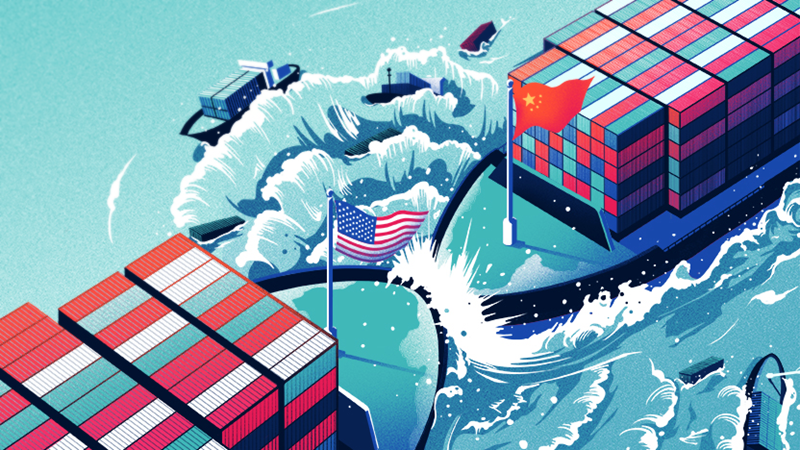
Từ thời Trump đến Biden, rồi quay lại Trump, xu hướng nâng thuế nhập khẩu, đặc biệt với Trung Quốc...
Read More







Views: 0

An attendant walks past EU and China flags ahead of the EU-China High-level Economic Dialogue at Diaoyutai State Guesthouse in Beijing, China June 25, 2018. REUTERS/Jason Lee
The European Union called out China on Saturday for endangering peace in the South China Sea and urged all parties to abide by a 2016 tribunal ruling which rejected most of China’s claim to sovereignty in the sea, but which Beijing has rejected.
The EU last week released a new policy aimed at stepping up its influence in the Indo-Pacific region to counter China’s rising power.
The Philippines on Friday protested to China over its failure to withdraw what it called as “threatening” boats believed to be manned by maritime militia around the disputed Whitsun Reef, which Manila calls the Julian Felipe Reef.
“Tensions in the South China Sea, including the recent presence of large Chinese vessels at Whitsun Reef, endanger peace and stability in the region,” a EU spokesperson said in a statement on Saturday.
EU reiterated its strong opposition to “unilateral actions that could undermine regional stability and international rules-based order”.
It urged all parties to resolve disputes peacefully in accordance with international law, and highlighted a 2016 international arbitration that had ruled in favor of the Philippines while invalidating most of China’s claims in the South China Sea.
China rejected EU’s accusation that its ships at Whitsun Reef, which China calls Niu’E Jiao, had endangered peace and security.
The Chinese Mission to the EU in a statement on Saturday reiterated that the reef is part of China’s Nansha Islands, or Spratly Islands, and that it was “reasonable and lawful” for Chinese fishing boats to operate there and shelter from the wind.
The Chinese statement also insisted that China’s sovereignty, rights and interests in the South China Sea were formed in the “long course of history and consistent with international law” and rejected the 2016 tribunal ruling as “null and void”.
“The South China Sea should not become a tool for certain countries to contain and suppress China, much less a wrestling ground for major-power rivalry,” the Chinese statement said.
China is increasingly worried that Europe and other countries are heeding U.S. President Joe Biden’s call for a “coordinated approach” towards China, which had so far materialised in the form of sanctions over its security crackdown in Hong Kong and treatment of Uyghur Muslims.
U.S. Secretary of State Antony Blinken last month said Washington “stands by its ally, the Philippines,” in the face of China’s massing maritime militia at Whitsun Reef.
Quelle:
https://www.reuters.com/world/china/eu-blames-china-endangering-peace-south-china-sea-2021-04-25/
Views: 0
Views: 0
Views: 0
Views: 0
Kết luận của Hội đồng về Chiến lược hợp tác của EU ở Ấn Độ Dương – Thái Bình Dương được 27 Bộ trưởng Ngoại giao của các nước thành viên EU thông qua ngày 19/4/2021 thể hiện sự nhận thức của EU về tầm quan trọng ngày càng tăng của khu vực này và cam kết củng cố vai trò của mình trong hợp tác với các đối tác tại đây.
Khu vực Ấn Độ Dương – Thái Bình Dương đại diện cho một trung tâm kinh tế và khu vực địa chiến lược quan trọng của thế giới. Đây là nơi sinh sống của 60% dân số thế giới, tạo ra 60% GDP toàn cầu, đóng góp cho 2/3 sự tăng trưởng toàn cầu hiện nay. Đến năm 2030, phần lớn (90%) trong tổng số 2,4 tỷ thành viên mới của tầng lớp trung lưu gia nhập nền kinh tế toàn cầu sẽ sống ở Ấn Độ Dương – Thái Bình Dương.
Sự hợp tác trong khu vực Ấn Độ Dương – Thái Bình Dương vô cùng quan trọng trong việc thực hiện nghị trình toàn cầu của cộng đồng quốc tế, bao gồm cả việc đạt được các Mục tiêu Phát triển bền vững của Liên hợp quốc. Trong những năm qua, EU đã liên tục có những đóng góp đáng kể trong khu vực về hợp tác phát triển và hỗ trợ nhân đạo, giải quyết vấn đề biến đổi khí hậu, tình trạng mất đa dạng sinh học và ô nhiễm môi trường, đồng thời góp phần duy trì luật pháp quốc tế, bao gồm cả vấn đề quyền con người và tự do hàng hải.
Do vậy, EU có một lợi ích lớn tại khu vực Ấn Độ Dương – Thái Bình Dương và có mọi lợi ích trong việc duy trì một cấu trúc khu vực cởi mở và dựa trên luật lệ. Tuy nhiên, những biến động hiện tại ở Ấn Độ Dương – Thái Bình Dương đã làm nảy sinh sự cạnh tranh địa chính trị gay gắt, làm gia tăng áp lực lên thương mại và các chuỗi cung ứng cũng như những căng thẳng trong các lĩnh vực công nghệ, chính trị và an ninh. 60% thương mại đường biển thế giới đi qua các đại dương của khu vực, trong đó một phần ba là đi qua Biển Đông. Các tuyến đường của khu vực này cần phải được duy trì sự tự do và cởi mở.
Đây là lý do vì sao các Bộ trưởng Ngoại giao EU đã quyết định củng cố trọng tâm chiến lược, sự hiện diện và các hành động của EU ở Ấn Độ Dương – Thái Bình Dương. Cách tiếp cận và sự can dự sẽ được thực hiện dựa trên một quan điểm dài hạn, với mục tiêu đóng góp vào sự ổn định, an ninh, thịnh vượng và phát triển bền vững của khu vực trên cơ sở thúc đẩy dân chủ, pháp quyền, nhân quyền và luật pháp quốc tế.
Cam kết mới đối với khu vực này bao trùm tất cả các đối tác có mong muốn hợp tác với EU. Chiến lược này mang tính thực tế, linh hoạt và đa diện một cách có chủ đích, cho phép EU thích ứng và xây dựng mối quan hệ hợp tác của mình theo các lĩnh vực chính sách cụ thể mà ở đó các đối tác có thể tìm thấy điểm đồng dựa trên các nguyên tắc, giá trị cùng chia sẻ hoặc lợi ích chung.
EU sẽ tăng cường sự can dự sâu hơn tại Ấn Độ Dương – Thái Bình Dương, đặc biệt là với những đối tác đã công bố các cách tiếp cận Ấn Độ Dương – Thái Bình Dương của riêng họ.
Việc thông qua Kết luận của Hội đồng cho phép EU tăng cường hợp tác hơn nữa trong nhiều lĩnh vực như quản trị đại dương, y tế, nghiên cứu và công nghệ, an ninh và quốc phòng, kết nối và củng cố hợp tác cùng nhau trong việc giải quyết các thách thức toàn cầu như biến đổi khí hậu.
EU mong muốn được hợp tác với mọi đối tác của mình trong tất cả các lĩnh vực này, đặc biệt là thực hiện nhiệm vụ chung trong giải quyết các tác động to lớn về kinh tế và con người của cuộc khủng hoảng COVID-19, đảm bảo một sự phục hồi kinh tế-xã hội xanh, bền vững và bao trùm đồng thời tạo ra các hệ thống y tế có sức chống chịu tốt hơn./.
Views: 0

Vietnam following its chairmanship in ASEAN in 2020 as well as the ongoing membership as a permanent member of the UN Security Council has provided the country with more maturity and adept outlook in addressing both security concerns as well as political manoeuvring in Southeast Asia. Vietnam has been very cautious of the fact that it cannot court the US as a guarantor of its stakes in South China Sea while at the same time could not annoy China to the verge of having a military dispute with a large communist country.
The well-deserved third term for the General Secretary of the Vietnamese Communist Party Nguyễn Phú Trọng has provided that foundation for Vietnam to embark on managing its relationship with the two major powers- the US and China in the Indo-Pacific. Vietnam has not subscribed to the US policy towards Indo-Pacific and has been carefully weighing its strategic and economic options. The tensions between US and China in South China Sea (SCS)and Chinese assertive posture on Taiwan has created unique predicament for Vietnam where it sees that in order to keep the two countries at a safe distance and maintain neutrality so that it does not impact security interest of Vietnam.
In order to not to rely on either the US or China for its security needs, it has been quietly working on upgrading its defences in South China Sea islands under its flag. This adroitness and deft diplomacy are likely to give Vietnam the benefit of the better trade relations with China while at the same time engaging the US in terms of its market and large-scale investment which are going to come from the US. Vietnam in the post COVID-19 scenario would require the help of both the countries. As the US has already promised to help upgrade Vietnam technological institutions and work on providing better avenues for education for the Vietnamese students. On the other hand, China has been cautious of the fact that it cannot annoy Vietnam to such an extent that it enters into a strategic partnership agreement with the US. Vietnam has been steadfastly maintaining its neutrality and has clearly remarked that it will not be ceding away the Cam Ranh Bay to anyone particular power and would be working for better cohesion in the ASEAN forums.
While a number of the US think tanks (Rand, Carnegie and others) have been propagating that Vietnam- China relations is going to get more troubled and complex but both the countries capitals have issued diplomatic statements buttressing their ideological solidarity and the frequent show of goodwill completely undermining the maritime disputes. Vietnamese government has very strongly tried to keep its diplomatic interactions with China on an equal footing while at the same time it has engaged with the European powers as well as the US so that they give due attention to Vietnamese requests related to South China Sea.
In the year 2020, Vietnam has used its diplomatic skilfulness as well as its media channels to outline the assertive role that China has been playing in South China Sea. Following this call for attention many countries including UK, Germany, France and the US along with many as ASEAN claimant countries to SCS dispute have buttressed and supported Vietnam’s position on these contentious islands. Vietnam during its ASEAN chairmanship has strongly supported the cause for the signing of the code of conduct and adopting a standard operating procedure in case of tensions between any two claimant countries. While it is acknowledged that Vietnam has been playing a constructive role in the UN Security Council but the presence of Vietnam and India at the same time as non-permanent members of UNSC has annoyed China to a certain extent. There is a feeling that China because of its complacency in the investigation of COVID-19 virus and also highhanded approach with regard to allowing the World Health Organization officials to investigate the genesis of virus has drawn strong rebuttals from the countries across the world. Further, China has been trying to downplay the vaccine diplomacy that India has been playing and it is expected that Vietnam might be procuring Indian vaccines because of their cheap cost and more effectiveness.
In one of the Rand reports titled ‘Regional Responses to U.S.-China Competition in the Indo-Pacific Vietnam’ written by Derek Grossman, which was published in the year 2020 which talks about the US -China competition in the Indo-Pacific and the role of Vietnam in that context. It clearly addresses the fact that China has an increasing in influence in Vietnam in comparison to the United States. It admits the fact that Beijing is dominant in Vietnam’s economic superstructure but also acknowledges the fact that the US -Vietnam ties could only be enhanced only if tensions between China and Vietnam reach a threshold or an armed conflict begins. As a countermeasure, the report recommended that United States should adopt a multifarious approach so as to engage with political leadership as well as economic majors so as to bring about unison with regard to commitment towards the United States priorities and interest. It also suggested that United States should provide alternative options in order to counter the Belt and Road Initiative of China. Interestingly, it also suggests that at a senior level the interaction should be promoted between US Air Force and Vietnamese air forces and the two sides should take up cooperative activities which are non-military in nature. Given the fact that Vietnam is acknowledged as a critical country for the US interests in the Indo-Pacific plan of action. Therefore, Washington is compelled to organically engage Vietnamese leaders and make them understand the utility of the US in for the larger security outlook of Vietnam. Vietnam’s constitution has maintained that the US is an adversary country and any engagement or negotiations with the US is not acceptable.
China has also been cautious that in the wake of tensions in SCS the issue should not aggravate to a maritime conflict. The strategic autonomy that Vietnam has maintained would be helpful in keeping SCS tensions within a limit and also help in maintaining the sanctity of multilateral negotiations under ASEAN rubric./.
Views: 0
Since 2019 Vietnam has been visibly improving its military facilities on several of the Spratly islands that China has been claiming even though the islands are closer to Vietnam and were often occupied by Vietnamese civilian or military facilities. The latest Vietnamese improvements are most obvious (via commercial satellite photos) on West Reef and Sin Cowe Island. The most obvious change in West Reef is that it is now larger (28 hectares/70 acres) and most of it is recently dredged up sand. Sim Cowe also had about 11 hectares of land added via dredged up sand. Most of that new land is now covered with military structures, including bunkers for coast defense guns or missiles, radars and ELINT (Electronic Intelligence) sensors plus landing pads (for helicopters) or short airstrips. Although Russia is an ally of China, that has not halted the sale of Russian submarines and other weapons to Vietnam. The United States recently proposed installing about $5 billion worth of missiles and sensors on islands within or near the South China Sea that are threatened by China.

To those unfamiliar with the South China Sea situation, the American proposal seemed to be a major escalation, but it isn’t. All the nations threatened by Chinese claims are improving the defenses on the islands they occupy. In addition, nearly once a month the U.S. sends warships through waters China claims in the South China Sea, and this is often done within sight of Chinese occupied islands. Many of these “islands” were recently created or expanded with dredged up sand.
China has always considered Vietnam the most aggressive opponent of Chinese claims, and the two countries have fought near disputed islands several times since the 1980s. Vietnam has not backed down but has been forced to back away several times and is preparing to make any future Chinese aggression very difficult, if not impossible without a major military operation. Vietnam knows that China wants to avoid being such an obvious aggressor in these matters because most nations, as well as international law (and the tribunals that hear appeals) oppose the Chinese claims.
China can be persuaded to back off. Vietnam was often the cause of failed Chinese aggression and embarrassed China. For this reason, China and Vietnam agreed to establish a hotline in 2013, after two years of negotiations, to ensure that any future disputes did not turn violent unintentionally. This was a good idea and the hotline was first proposed by China because Vietnam and China have been fighting each other for centuries. In the past the violence was mainly over disagreements about Vietnam’s status. China considered Vietnam a rebellious province, while Vietnam considered itself independent.
In the late 19th century French forces were invited in to support one faction in another round of Vietnamese internal strife. The French soon took over all of what is now Vietnam and united all of Vietnam for the first time. Despite extensive Chinese help in fighting the French after World War II and support for North Vietnam efforts to invade South Vietnam, China and a reunited Vietnam fought a short war in 1979. Technically China won, but in reality the Chinese got clobbered and have never got over that. In 1988 China and Vietnam fought a naval battle off the Spratly islands. This was a Chinese victory, in which a Chinese warship sank a Vietnamese transport carrying troops headed for one of the disputed islands. This was followed by Chinese troops establishing garrisons on some of the islands. In 1992, Chinese marines landed on Da Lac reef, in the Spratly Islands. In 1995, Chinese marines occupied Mischief Reef, which was claimed by the Philippines, but as a pointed reminder to Vietnam as well. China has since expanded its naval infantry force and built several large amphibious warships to land naval infantry on a defended island. With this history of violence, and continued disputes over some islands, a hot-line was a good idea but Vietnam still fears Chinese aggression and is preparing for more fighting.
This growing animosity is not restricted to Vietnam. China continues to threaten nations that get too close to the Chinese coast, or challenge Chinese territorial claims. The only problem is that China has a definition of territorial waters that the international community does not recognize. International law (the 1994 Law of the Sea treaty) recognizes the waters 22 kilometers from land as under the jurisdiction of the nation controlling the nearest land. That means ships cannot enter these “territorial waters” without permission. Moreover, the waters 360 kilometers from land are considered the Exclusive Economic Zone (EEZ), of the nation controlling the nearest land. The EEZ owner can control who fishes there, and extracts natural resources (mostly oil and gas) from the ocean floor. But the EEZ owner cannot prohibit free passage, or the laying of pipelines and communications cables. China, however, claims that foreign military ships and aircraft cannot enter its EEZ, and sometimes uses force to block entry. This is usually done with Chinese owned fishing or cargo ships, which move very close and persuade the “invaders” to leave. It is feared that eventually China will use one of its growing number of warships to challenge some foreign warship “invading” its EEZ. The 1994 treaty says nothing about blocking warships from your EEZ, but some nations believe it is allowed. China is simply doing what China has been doing for centuries, trying to impose its will on neighbors, or anyone venturing into what China considers areas under its control.
For the last three centuries, China claims it has been prevented from exercising its “traditional rights” in nearby waters because of the superior power of foreign navies. First it was the cannon armed 16th century European sailing ships, then, in the 19th century, newly built steel warships from Japan. However, since the communists took over China 70 years ago, there have been increasingly violent attempts to reassert Chinese control over areas that have, for centuries, been considered part of the “Middle Kingdom” (or “zhong-guo”, as in the “center of the world”).
China’s other neighbors are also responding to this aggressive attitude. Taiwan has reinforced garrisons on disputed islands in the South China Sea. Taiwan is particularly concerned about the Pratas Islands, which only China and Taiwan dispute control of. These are 340 kilometers southeast of Hong Kong, and 850 kilometers southwest of Taiwan. Only one of the three islands is above water, and it (Pratas Island) is 2.8 kilometers long and 850 meters wide. There were never any permanent inhabitants. Taiwan not only maintains a military garrison and an air strip there, but is adding anti-aircraft and anti-ship missiles as well. There is also “service station” for fisherman and researchers working on the island or nearby. Taiwan is upgrading the defenses of several of the disputed islands it still occupies,
More valuable and more newsworthy, though, are a larger group of islands south of the Pratas. These are the Spratlys, a group of some 100 islets, atolls, and reefs that total only about 5 square kilometers of land, but sprawl across some 410,000 square kilometers of the South China Sea. Set amid some of the world’s most productive fishing grounds, the islands are believed to have enormous oil and gas reserves. Several nations have overlapping claims on the group. About 45 of the islands are currently occupied by small numbers of military personnel. China claims them all, but occupies only 8, Vietnam has occupied or marked 25, the Philippines 8, Malaysia 6, and Taiwan one.
In 2009 Taiwan built a 1,150 meter long, and 30-meter-wide air strip on Itu Aba, one of the Spratly Islands, 500 kilometers to the south. Called Taiping Island by the Taiwanese, Ita Aba is one of the largest of Spratly Islands, at about 120 acres (489,600 square meters). It has been in Taiwanese hands since the mid-1950s and has largely been used as a way station for fishermen. The island is also claimed by the Vietnamese, who call it Thai Binh. Taiwan has long maintained a small military presence on the island, and an air strip is meant to cement that control. Taiwan has since upgraded its military facilities on Ita Aba. Protests were made by Vietnam, which controls the largest group of islands, and the Philippines, which also claimed Itu Aba Island. Vietnam refurbished an old South Vietnamese airstrip on Big Spratly Island. For over a decade both the China and Vietnam have been building more structures, including armed bunkers, on the Spratly islands they occupy. Malaysia has built an air strip on its Spratly island, which it uses to fly in tourists looking for prime scuba diving. There are now believed to be seven airports in the Spratlys; three for China and one each for Taiwan, Malaysia, Philippines and Vietnam. There are several other islands with air strips or plans to build one.
China has used force, or the threat of force, to prevent Vietnam from carrying out exploration for oil and natural gas in offshore waters where international law recognizes Vietnamese exploration rights. As recently as 2020, Chinese threats forced a British firm to back off on a billion-dollar oil exploration contract it had with Vietnam,
China is also demanding that the Philippines halt oil exploration in the Spratly Islands, without saying exactly what would happen otherwise. The Philippines has asked the United States to help establish Filipino claims in the Spratly islands. China claims to own any oil and gas throughout the South China Sea. This claim is not recognized by any international agreement. China is apparently trying to bully other claimants, especially the Philippines and Vietnam, into staying away from these potential assets. All China offers are vague promises of “sharing” these undersea bonanzas. But the implication is that China will get most of the profits, with the other claimants getting little. China insists that the U.S. should stay out of this dispute as it is not one of the claimants. The quarrel has sparked nationalist passions in all the nations involved. The United States has said it will stand by many of the non-Chinese claims, and now the Americans are proposing extensive military cooperation with the nations threatened by Chinese offshore claims.
The small countries all fear that China will eventually make good on its long-standing claim to all the Spratlys, as well as all similar islands and reefs in the South China Sea. At that point, the international community will have to worry about continued free passage through an area that currently sees about two trillion dollars’ worth of cargo moved through each year. With this in mind, the United States is backing China’s neighbors, and refusing to bend to Chinese demands./.
Views: 0
Views: 0
Views: 0
Views: 0
Views: 0
Views: 0
Views: 0
Views: 0
Views: 0
Views: 0
Views: 0
Pham Minh Trang
Most observers usually look at the South China Sea disputes with pessimistic eyes. After capturing the attention of the world in 2009, when China for the first time officially introduced the nine-dash-line map, the conflicts in the region has continued to grow, tensions between the interested parties increasing. Furthering tensions, China ignored the judgment of an international tribunal in a 2016 suit against Beijing’s expansive claims. Thereafter, some observers have claimed that the disputes are too complicated to settle by law. But such pessimism ignores the fact that Southeast Asian countries have a culture of heeding international law. Whether judging from a realist lens or not, the law remains a useful tool for small countries to protect their interests.

Not So Complicated
From a legal perspective, disputes in the South China Sea are not as complicated as they may seem. There are two reasons for that statement.
First, all the claimants in the South China Sea – Brunei, China, Malaysia, the Philippines, and Vietnam – are parties to the two most important legal mechanisms dealing with multilateral disputes: the United Nations Charter (UN Charter) and the United Nations Convention on the Law of the Sea (UNCLOS). Under the regimes of these conventions, state parties have the obligation to settle their disputes by peaceful means, such as negotiation, regional arrangements, international arbitration, or courts/tribunals. Unlike the UN Charter, UNCLOS goes a step further and prescribed detailed methods of solving conflicts at sea for its parties in Chapter XV. In general, the consent of states is placed at the center of all dispute settlement mechanisms. However, UNCLOS particularly opens a chance for a state party individually to bring its conflict with another state before an international court or arbitration when it comes to certain types of disputes. These are called compulsory procedures, entailing binding decisions in section 2 of chapter XV of UNCLOS. When a state signed and ratified the Convention, it is understood that it has agreed with this settlement means in advance. This was the strategy the Philippines employed in its litigation against China in the South China Sea arbitration.
The second reason is that the whole situation in the South China Sea can be classified into specific legal categories, which could be settled separately by law.
The first category is related to conflicting claims of sovereignty over offshore maritime features. China and Vietnam claim sovereignty over all the features in the Paracels. For the Spratlys, the claimants include China, Brunei, Malaysia, the Philippines and Vietnam.
The second category concerns normal maritime boundary demarcation exercises of littoral countries. Coastal states usually have maritime zones overlapping with their opposite and/or adjacent neighbors, and so do the claimants in the South China Sea. For example, Vietnam and Malaysia have overlapping exclusive economic zones (EEZ) and continental shelves, or Brunei when extending its EEZ and continental shelf has recognized the future delimitation of boundaries with neighbors in the future. And there is China, which claims a maritime zone comprising 80 percent of the South China Sea within the infamous nine-dash-line. This claim, however, was rejected by the arbitral tribunal in the case between the Philippines and China in 2016.
Another group of disputes is related to the legal status of maritime feature in the South China Sea. According to UNCLOS, offshore features can be classified as “islands,” “rocks” or “low-tide elevations” with different legal effects. The Tribunal in the South China Sea case decided that all the features in the Spratlys Islands are not “islands.” They are either “rocks” or “low-tide-elevations,” and while “rocks” can generate a 12 nm maritime zone around them, “low-tide-elevations” are unable to have any independent maritime zone, regardless of being made into artificial islands or not.
The last groups of disputes mostly involve China. China’s artificial island building activities have harmfully affected the maritime environment in the area; in addition, China has disturbed economic activities of Malaysia, the Philippines and Vietnam in their EEZs and continental shelves.
All of the above-mentioned issues are addressed by international law, from treaty laws to customary international law. Except for the first two groups of disputes, which require explicit consent of both parties in order to bring them before an international judicial body, the rest do not need the same requisition. In fact, they fall neatly into the compulsory procedure under part XV of UNCLOS. More significantly, according to the decision on the jurisdiction of the Arbitral Tribunal in the South China Sea case, the dispute concerning the legal status of maritime features can be distinguished and settled separately from the dispute of their sovereignty.
In short, some disputes in the South China Sea can be settled first, paving the way for dealing with the more difficult issues later. In addition, not all issues in the South China Sea involve China; hence, other disputing parties can work together to solve problems between themselves. Fortunately, for those countries, international law is always an option.
Southeast Asia’s Culture of International Law
Except for China, the other claimants in the South China Sea (Brunei, Malaysia, the Philippines and Vietnam) are members of the Association of Southeast Asian Nations (ASEAN), and the countries in this organization have a culture of international law. For example, Singapore and Malaysia asked the International Court of Justice (ICJ) to make the final decision on problems concerning sovereignty over maritime features. Similarly, Indonesia and Malaysia have also settled a sovereignty dispute over some islands by the ICJ. Myanmar and its neighbor, Bangladesh, brought their maritime delimitation issues to International Tribunal for the Law of the Sea (ITLOS). The Philippines made history when initiating a case against China before an international arbitral tribunal, marking the first lawsuit about the South China Sea disputes. Furthermore, the member states of ASEAN have also approached to maritime problems, especially maritime boundary issues, with good faith, flexibility and modest cooperation.
Those countries also have a convenient tool to solve their regional disagreements: ASEAN. Indeed, the friendly and partnership environment of a myriad ASEAN meetings could be better for negotiation between relevant disputed states. Besides, according to article 23 of the ASEAN Charter, member states can request the chairman or the secretary-general of ASEAN provide good offices, conciliation and mediation.
Therefore, it is tenable to argue that ASEAN countries should settle disputes among themselves in the South China Sea first, especially delimiting their maritime borders. This practice will help them to build up more weight on the negotiation table with Beijing. Another lawsuit against China in the South China Sea, regardless of its consent, is also a possibility. Then, they will achieve certain pressures making China reconsidering its illegal activities at sea.
This article was first published on The Diplomat.
Views: 0
China aims to prevent disputes in the South China Sea from becoming a multilateral issue, and seeks ways to solve tensions through bilateral negotiations. Beijing does not want an influential third party like Japan to enter the region.
With this consistent intention, China has used all resources, including economic power and diplomatic influence, to entice a number of ASEAN member states. According to analysts, “maintaining the status quo” will be detrimental and will force ASEAN countries that are in conflict with China in the South China Sea to make concessions, while giving the opportunity for Beijing to create “the past”, such as: reclaiming entities illegally occupied by this country, building runways, sending weapons and military equipment to artificial islands, harassing fishermen, harassing legal oil and gas exploitation of other countries. With overwhelming military size and strength, China will seek to gradually eliminate ASEAN countries to gain control most of the South China Sea.
On the Japanese side, this country always shows the viewpoint of maintaining peace, ensuring security, freedom of navigation and international law in the South China Sea. In 2016, Japanese Foreign Minister Fumio Kishida declared the PCA ruling on the Philippines lawsuit against China as final and legally binding. Tokyo also urged Beijing to accept and comply with the PCA’s ruling, avoiding actions that could escalate tensions in the South China Sea.

Japan’s battleship
Contrary to China’s strategy, Japan is working with the US to promote internationalization of the South China Sea issue. Japan also directly assists a number of countries that have disputes with China in the South China Sea by helping to increase maritime warning capabilities and coast guard.
Recently, Japan has increased its direct involvement and close coordination with the US, India and Australia in the South China Sea. In October 2020, the Japan Coast Guard conducted an anti-submarine exercise in the East Sea, and three participating ships stopped at Cam Ranh Bay of Vietnam for supplement logistics. Before that, Japan sent a helicopter carrier and a destroyer to participate in joint naval exercises with Indonesia in the western Natuna Islands. In August 2020, Japan protested against China’s launch of ballistic missiles into the South China Sea.
The situation in the South China Sea continues to be tense and will attract more and more influential countries to participate. This poses a great challenge for ASEAN in balancing relations with these parties, including Japan and China. However, this is also an opportunity for ASEAN to take advantage of its central role in an unpredictable world to effectively resolve regional issues, including the South China Sea disputes./.
Views: 0
